







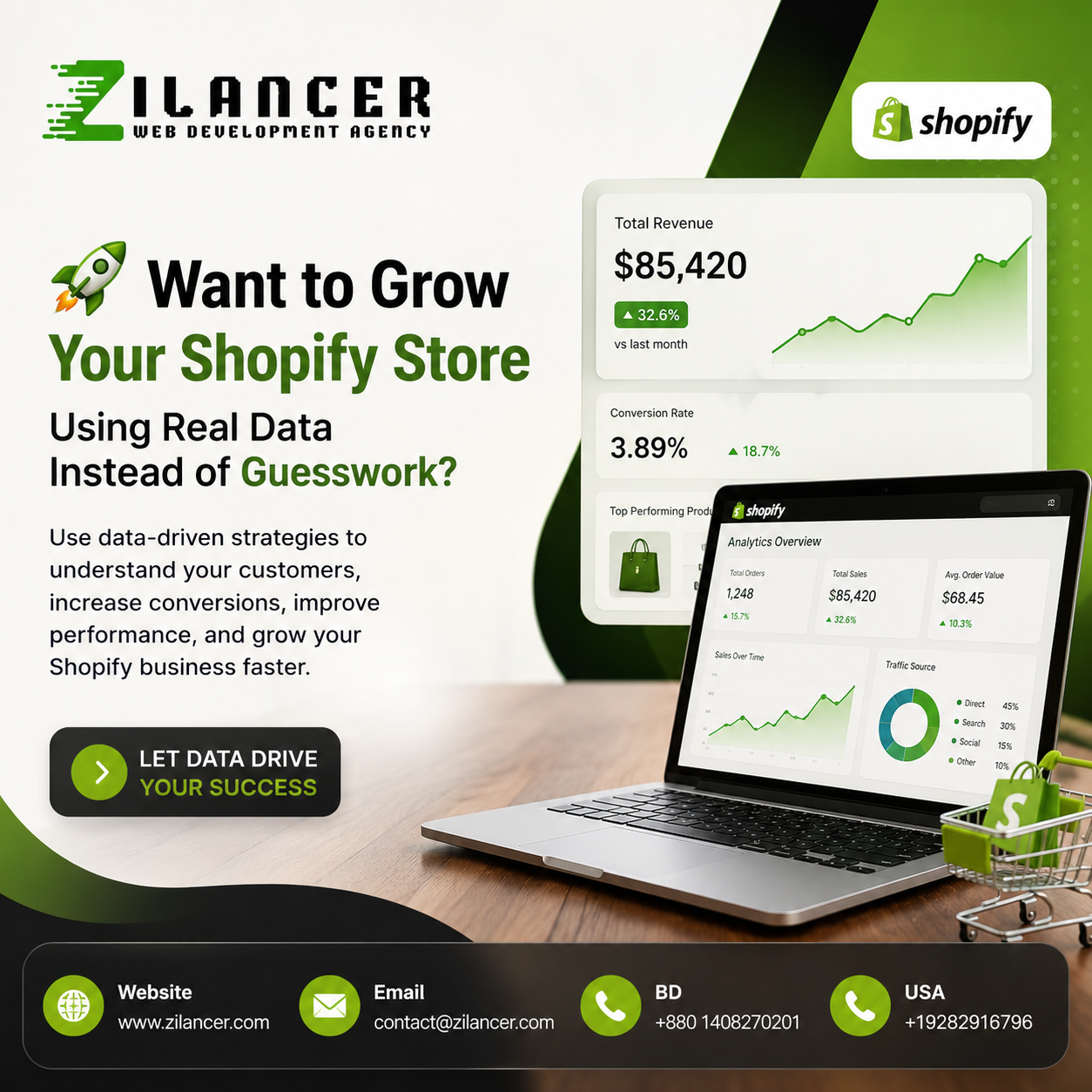
The Shopify ecosystem has become one of the most competitive environments in the world of eCommerce. Every day, thousands of online stores compete for customer attention, making it increasingly difficult for brands to stand out and achieve sustainable growth. While many Shopify merchants focus heavily on products, design, and advertising, the most successful businesses understand that long-term success is built on data-driven decision-making. A data-driven Shopify growth strategy enables businesses to make informed decisions based on real customer behavior rather than assumptions. Instead of relying on guesswork, successful brands use analytics, customer insights, conversion data, and performance metrics to optimize every aspect of their online stores. This approach helps businesses identify opportunities, eliminate inefficiencies, improve customer experiences, and maximize profitability.
Modern consumers generate valuable data throughout their shopping journey. Every page view, product click, cart addition, purchase, and interaction provides insights into customer preferences and behaviors. When analyzed correctly, this information becomes a powerful resource that can guide business growth strategies and improve overall performance.
At Zilancer, we help Shopify businesses unlock the full potential of their data. Through advanced analytics, conversion optimization, Shopify development, SEO, and growth-focused strategies, we transform raw information into actionable insights that drive measurable business results. Our goal is not simply to improve website performance but to create scalable growth systems that generate long-term success.
Why Data Matters More Than Ever in Shopify Growth
In today’s rapidly evolving eCommerce landscape, data has become one of the most valuable assets a Shopify business can possess. The days of making business decisions based solely on intuition, assumptions, or industry trends are quickly disappearing. Modern Shopify brands that achieve sustainable growth are those that understand how to collect, analyze, and act on data effectively. As competition increases and customer expectations continue to evolve, data-driven decision-making has become essential for businesses that want to stay ahead and maximize their growth potential. Every interaction within a Shopify store generates valuable information. From the moment a visitor lands on a website, data begins to reveal insights about customer behavior, preferences, purchasing patterns, and engagement levels. This information helps merchants understand what is working, what is not, and where opportunities for improvement exist. Rather than guessing why sales fluctuate or why certain products perform better than others, data provides clear answers that support smarter business decisions. One of the primary reasons data matters so much in Shopify growth is its ability to improve customer understanding. Modern consumers leave digital footprints throughout their shopping journey. They browse products, click on specific pages, abandon carts, complete purchases, and interact with marketing campaigns. By analyzing these behaviors, Shopify merchants can gain a deeper understanding of customer interests, motivations, and pain points. These insights allow businesses to create more relevant experiences that resonate with their target audience and increase conversion rates.
Data also plays a critical role in identifying opportunities for optimization. Many Shopify stores experience hidden inefficiencies that limit growth without the owner’s awareness. Customers may be leaving during checkout, product pages may not be converting effectively, or marketing campaigns may be targeting the wrong audience segments. Without accurate data, these issues can remain undetected for long periods of time. Analytics and performance tracking reveal these bottlenecks, allowing businesses to make informed improvements that directly impact revenue and profitability. Marketing effectiveness has become increasingly dependent on data. Advertising costs continue to rise across major platforms, making it more important than ever to maximize return on investment. Data-driven marketing enables Shopify businesses to track campaign performance, measure customer acquisition costs, identify high-performing channels, and allocate budgets more efficiently. Instead of relying on broad assumptions, merchants can invest resources in strategies that deliver measurable results and eliminate campaigns that fail to generate sufficient returns. Another major advantage of data is its ability to support personalization. Today’s consumers expect brands to understand their preferences and provide tailored experiences. Data allows Shopify stores to personalize product recommendations, email campaigns, promotional offers, and customer journeys based on actual behavior and interests. Personalized experiences increase customer engagement, improve satisfaction, and often lead to higher conversion rates and greater customer loyalty. As personalization becomes an industry standard, businesses that leverage data effectively gain a significant competitive advantage.
Data is equally important for improving the customer experience. User behavior analysis can reveal how visitors navigate a Shopify store, where they encounter difficulties, and what factors contribute to purchase decisions. By understanding these interactions, merchants can create smoother shopping experiences that reduce friction and encourage conversions. Small improvements to navigation, product presentation, page speed, and checkout processes can have a substantial impact on customer satisfaction and overall business performance. Inventory management is another area where data-driven strategies create significant value. Overstocking products can tie up capital and increase storage costs, while understocking can result in lost sales opportunities and frustrated customers. By analyzing sales trends, seasonal patterns, and customer demand, Shopify merchants can make more informed inventory decisions. This improves operational efficiency while ensuring that customers can access the products they want when they need them. Search engine optimization also benefits greatly from data analysis. Effective SEO is no longer based solely on keyword placement. Successful Shopify businesses use data to understand search intent, identify valuable keyword opportunities, monitor rankings, and analyze competitor performance. Data-driven SEO strategies help stores attract highly targeted organic traffic while improving visibility in search engine results. This creates a sustainable source of growth that complements paid advertising efforts.
As businesses scale, the importance of data becomes even greater. Growth often introduces new challenges, including larger product catalogs, more complex customer journeys, increased marketing budgets, and expanded operational requirements. Data provides the visibility needed to manage this complexity effectively. Business owners can track key performance indicators, monitor profitability, evaluate growth initiatives, and make strategic decisions with greater confidence. The ability to predict future trends is another powerful advantage of data-driven growth strategies. Historical performance data can reveal emerging patterns, seasonal fluctuations, customer behavior trends, and market opportunities. This predictive insight allows Shopify merchants to prepare for future demand, optimize marketing efforts, and make proactive business decisions rather than simply reacting to changes after they occur. At Zilancer, we believe that data is the foundation of sustainable Shopify growth. Our team helps businesses transform raw analytics into actionable insights that drive meaningful results. Through advanced reporting, customer behavior analysis, conversion rate optimization, Shopify development, SEO, and strategic consulting, we help merchants make informed decisions that improve performance across every area of their business. Rather than relying on assumptions, we empower businesses to build growth strategies backed by measurable evidence and real-world customer behavior. As eCommerce continues to become more competitive, the ability to leverage data effectively will separate successful brands from those that struggle to keep pace. Data provides clarity, reduces uncertainty, improves efficiency, and creates opportunities for continuous improvement. Shopify businesses that embrace a data-driven mindset are better equipped to understand their customers, optimize their operations, and achieve long-term success in an increasingly dynamic digital marketplace.
Ultimately, data matters more than ever because it transforms decision-making from guesswork into strategy. It enables businesses to understand what customers want, identify opportunities for growth, improve marketing performance, and create exceptional shopping experiences. For Shopify merchants seeking sustainable growth and lasting competitive advantages, embracing data-driven strategies is no longer optional—it is essential.
Understanding Customer Behavior Through Analytics
In the modern eCommerce landscape, understanding customer behavior is one of the most important factors in achieving long-term Shopify success. While attracting traffic to an online store is essential, true growth comes from understanding what visitors do after they arrive. Every click, page view, search query, product interaction, and purchase tells a story about customer preferences, motivations, and decision-making processes. Analytics transforms these actions into valuable insights, allowing Shopify merchants to make informed decisions that improve customer experiences and drive business growth. Customer behavior analytics involves collecting, measuring, and analyzing data related to how visitors interact with a Shopify store. Rather than relying on assumptions or guesswork, analytics provides a clear picture of what customers are doing throughout their shopping journey. This information helps businesses identify patterns, understand customer needs, and uncover opportunities for optimization. In a competitive online marketplace, these insights can provide a significant advantage by helping merchants create more effective growth strategies. One of the primary benefits of customer behavior analytics is the ability to understand how visitors navigate a website. Every customer follows a unique path from arrival to purchase, and analytics reveals which pages attract attention, where users spend the most time, and what actions they take before converting. By studying these pathways, Shopify merchants can identify which elements of their stores contribute to conversions and which areas may be creating friction. Understanding these behaviors allows businesses to refine the customer journey and improve overall user experience. Analytics also helps businesses identify high-performing products and categories. Some products naturally attract more attention than others, while certain collections generate stronger engagement and sales. By examining product performance data, Shopify merchants can gain valuable insights into customer preferences and purchasing trends. This information can guide inventory planning, marketing campaigns, product development, and merchandising strategies. Instead of making assumptions about what customers want, businesses can rely on actual behavioral data to make more strategic decisions.
Cart abandonment remains one of the most common challenges in eCommerce, and customer behavior analytics plays a critical role in addressing this issue. Many shoppers add products to their carts but leave before completing their purchases. Analytics helps identify where abandonment occurs and what factors may be contributing to the problem. Whether the issue involves unexpected shipping costs, complicated checkout processes, lack of trust signals, or insufficient payment options, behavioral data helps uncover the root causes. Once identified, merchants can implement targeted improvements that reduce abandonment rates and increase completed transactions. Another important aspect of customer behavior analysis is understanding traffic sources and visitor quality. Not all traffic is equally valuable. Some marketing channels generate highly engaged visitors who are likely to convert, while others may drive large volumes of traffic with little purchasing intent. Analytics enables Shopify merchants to evaluate the effectiveness of different acquisition channels, including search engines, social media platforms, email campaigns, paid advertising, and referral traffic. By understanding which channels deliver the highest-quality visitors, businesses can allocate marketing budgets more effectively and maximize return on investment.
Customer segmentation is another powerful advantage of analytics. Different groups of customers often behave differently based on factors such as demographics, purchase history, interests, and shopping habits. Analytics allows Shopify businesses to identify these segments and create more targeted marketing strategies. By understanding the unique characteristics of different customer groups, merchants can deliver more personalized experiences, relevant product recommendations, and tailored messaging that increase engagement and conversion rates. The ability to track customer engagement is also essential for optimizing online store performance. Metrics such as bounce rate, session duration, page views, and repeat visits provide valuable insights into how customers interact with a website. High engagement often indicates that visitors find the content, products, and overall experience valuable. Conversely, low engagement may signal issues that need attention. By continuously monitoring engagement metrics, Shopify merchants can identify areas for improvement and enhance the overall customer experience. Analytics plays a crucial role in understanding customer intent. Not every visitor arrives at a Shopify store with the same objective. Some customers are conducting research, others are comparing products, and some are ready to make immediate purchases. Behavioral data helps merchants distinguish between these different stages of the buying journey. Understanding customer intent allows businesses to deliver appropriate content and offers that guide visitors toward conversion while addressing their specific needs and concerns. Predictive analytics is becoming increasingly valuable for Shopify businesses seeking long-term growth. By analyzing historical customer behavior, businesses can identify patterns that help forecast future actions. Predictive insights can reveal which customers are likely to make repeat purchases, which products may experience increased demand, and which marketing campaigns are most likely to succeed. These forecasts enable businesses to make proactive decisions that improve efficiency and drive revenue growth.
Customer lifetime value is another key metric that can be enhanced through behavioral analytics. Understanding which customers generate the most long-term value allows Shopify merchants to focus retention efforts on their most profitable audience segments. By identifying behaviors associated with high-value customers, businesses can create loyalty programs, personalized experiences, and retention strategies that strengthen customer relationships and increase lifetime revenue. Analytics also supports continuous improvement by enabling data-driven testing and optimization. Shopify merchants can evaluate the performance of different design elements, product page layouts, promotional strategies, and marketing campaigns through measurable results. Rather than relying on assumptions, businesses can use behavioral data to determine which changes produce the greatest impact. This process of ongoing optimization helps create more effective customer experiences and stronger business outcomes over time.
At Zilancer, we believe that customer behavior analytics is the foundation of successful Shopify growth. Our team helps businesses transform complex data into actionable insights that improve performance across every stage of the customer journey. Through advanced analytics, conversion rate optimization, customer experience enhancements, and strategic consulting, we help Shopify merchants better understand their audiences and make smarter business decisions. By leveraging customer behavior data, businesses can uncover hidden opportunities, improve marketing efficiency, and create shopping experiences that drive long-term success. As eCommerce continues to evolve, understanding customer behavior through analytics will become even more important. Businesses that invest in data-driven insights gain a deeper understanding of their customers, enabling them to adapt to changing preferences and market conditions. In a world where customer expectations continue to rise, analytics provides the clarity needed to deliver exceptional experiences and maintain a competitive advantage. Ultimately, the more a Shopify business understands its customers, the better positioned it is to attract, engage, and retain them for sustainable growth.
The Role of Conversion Rate Optimization in Shopify Success
In the highly competitive world of eCommerce, attracting visitors to a Shopify store is only one part of the growth equation. While traffic generation through SEO, paid advertising, social media marketing, and email campaigns is important, success ultimately depends on how effectively a store converts visitors into customers. This is where Conversion Rate Optimization, commonly known as CRO, becomes one of the most powerful strategies for achieving sustainable Shopify growth. Conversion Rate Optimization focuses on improving the percentage of website visitors who complete a desired action, whether that action is making a purchase, subscribing to an email list, requesting a consultation, or engaging with key content. Many Shopify businesses invest significant resources into driving traffic but overlook the importance of optimizing the customer journey. As a result, they attract visitors who leave without taking action. Even small improvements in conversion rates can generate substantial increases in revenue without requiring additional marketing spending. This makes CRO one of the most cost-effective growth strategies available to online stores. Rather than constantly increasing advertising budgets, Shopify merchants can maximize the value of existing traffic by creating experiences that encourage more visitors to convert. At its core, Conversion Rate Optimization is about understanding customer behavior and removing obstacles that prevent users from completing purchases. Every visitor arrives at a Shopify store with expectations, questions, concerns, and goals. If the shopping experience fails to meet those expectations, customers may leave before converting. CRO helps identify these friction points and implement solutions that improve usability, build trust, and guide customers toward making confident purchasing decisions.
One of the most important elements of Conversion Rate Optimization is improving the customer journey. A customer journey encompasses every interaction a visitor has with a Shopify store, from landing on the homepage to completing the checkout process. Each step presents opportunities to either encourage or discourage conversion. If navigation is confusing, product information is incomplete, or the checkout process is unnecessarily complicated, customers may abandon their purchases. CRO focuses on creating smooth, intuitive experiences that reduce effort and increase satisfaction throughout the shopping journey. Product pages play a particularly significant role in Shopify conversion rates. These pages often serve as the final decision-making point before a purchase occurs. Effective product pages provide clear descriptions, high-quality images, compelling value propositions, customer reviews, trust signals, and persuasive calls to action. Conversion optimization involves continuously evaluating and refining these elements to ensure they effectively address customer concerns and motivate purchasing behavior. Well-optimized product pages can dramatically increase sales by providing customers with the confidence they need to complete transactions.
Trust is another critical factor in Conversion Rate Optimization. Online shoppers cannot physically inspect products before making purchases, which naturally creates uncertainty. To overcome this challenge, Shopify stores must establish credibility and reassure customers that they are making safe and informed decisions. Trust-building elements such as customer testimonials, verified reviews, secure payment badges, transparent shipping policies, money-back guarantees, and professional website design all contribute to higher conversion rates. CRO strategies often focus heavily on strengthening trust signals because customer confidence directly influences purchasing behavior. Website speed and performance also have a significant impact on conversion success. Modern consumers expect fast-loading websites and seamless user experiences. Even minor delays can increase bounce rates and reduce conversions. Studies consistently show that customers are more likely to abandon websites that load slowly or perform poorly. Conversion Rate Optimization includes analyzing website performance and implementing technical improvements that enhance speed, responsiveness, and overall user experience. Faster websites not only improve customer satisfaction but also support stronger search engine rankings and better overall business performance. Mobile optimization has become increasingly important as mobile commerce continues to grow. A significant percentage of Shopify traffic now comes from smartphones and tablets. If a website is not fully optimized for mobile users, businesses risk losing valuable sales opportunities. CRO strategies ensure that mobile visitors can browse products, navigate pages, and complete purchases easily, regardless of the device they use. A seamless mobile experience is no longer optional; it is essential for maximizing conversions in today’s eCommerce environment.
Data analysis is at the heart of effective Conversion Rate Optimization. Successful CRO is not based on assumptions or personal opinions. Instead, it relies on measurable evidence gathered from customer interactions, website analytics, heatmaps, session recordings, and user behavior reports. These insights reveal how visitors engage with a Shopify store and identify areas where improvements can generate meaningful results. By understanding what customers are doing and why they may be leaving without converting, businesses can make informed decisions that improve performance.A/B testing is one of the most valuable tools used in CRO. This process involves comparing different versions of website elements to determine which performs better. Businesses can test headlines, product images, call-to-action buttons, layouts, pricing displays, promotional messages, and other components to identify the most effective combinations. Over time, these incremental improvements can produce significant increases in conversion rates and overall revenue.Cart abandonment represents one of the greatest opportunities for conversion optimization. Many customers add products to their carts but leave before completing their purchases. CRO strategies focus on understanding the reasons behind abandonment and implementing solutions to reduce it. Simplified checkout processes, transparent pricing, guest checkout options, trust-building elements, and abandoned cart recovery campaigns can all help improve completion rates and recover lost revenue.
Personalization is another increasingly important aspect of Conversion Rate Optimization. Customers respond more positively to experiences that feel relevant to their needs and interests. Personalized product recommendations, dynamic content, targeted offers, and customized shopping experiences can increase engagement and encourage purchases. By leveraging customer data and behavioral insights, Shopify merchants can create more meaningful interactions that improve conversion performance. At Zilancer, Conversion Rate Optimization is a core component of our Shopify growth strategy. We understand that increasing traffic alone is not enough to achieve sustainable business growth. Our team focuses on analyzing customer behavior, identifying conversion barriers, and implementing data-driven improvements that maximize the effectiveness of every visitor. From user experience enhancements and checkout optimization to trust-building strategies and advanced analytics, we help Shopify businesses create stores that convert more visitors into loyal customers. Our CRO approach is built on continuous improvement. The digital marketplace is constantly evolving, and customer expectations change over time. Through ongoing testing, performance monitoring, and optimization, we ensure that Shopify stores remain competitive and continue delivering strong results. By focusing on measurable outcomes rather than assumptions, we help businesses achieve higher conversion rates, increased revenue, and stronger returns on their marketing investments.
As competition in eCommerce becomes more intense, Conversion Rate Optimization will continue to play a crucial role in Shopify’s success. Businesses that prioritize CRO gain a significant advantage by maximizing the value of their traffic, improving customer experiences, and increasing profitability. Rather than relying solely on acquiring more visitors, successful Shopify brands focus on converting a greater percentage of the visitors they already have. This strategic approach creates sustainable growth and positions businesses for long-term success in an increasingly competitive digital marketplace. Ultimately, Conversion Rate Optimization is not just about increasing sales. It is about creating better experiences for customers, understanding their needs, and making it easier for them to achieve their goals. When businesses focus on delivering exceptional shopping experiences and continuously improving performance through data-driven strategies, conversions naturally follow. This is why CRO remains one of the most valuable investments a Shopify business can make in its growth journey.
Leveraging Customer Data for Personalized Experiences
In today’s competitive eCommerce environment, customers expect more than generic shopping experiences. They want brands to understand their preferences, anticipate their needs, and provide relevant recommendations throughout their buying journey. As consumer expectations continue to evolve, personalization has become one of the most effective strategies for increasing engagement, improving customer satisfaction, and driving Shopify growth. At the heart of successful personalization lies customer data. When collected and utilized effectively, customer data enables Shopify businesses to create meaningful shopping experiences that feel tailored to each individual visitor. Customer data is one of the most valuable assets available to modern eCommerce businesses. Every interaction within a Shopify store generates information that can provide insights into customer behavior, interests, purchasing habits, and preferences. From browsing history and product views to purchase records and engagement patterns, these data points help businesses understand who their customers are and what they are looking for. Rather than treating every visitor the same, Shopify merchants can use these insights to deliver experiences that are more relevant, engaging, and effective. Personalization begins with understanding customer behavior. When a visitor browses specific products, spends time exploring particular categories, or repeatedly searches for similar items, they reveal valuable information about their interests. By analyzing these behaviors, Shopify stores can recommend products that align with customer preferences. These recommendations help shoppers discover relevant products more easily while increasing the likelihood of additional purchases. Product recommendations have become one of the most widely used personalization techniques because they create a better customer experience while simultaneously boosting revenue and average order value.
One of the greatest advantages of leveraging customer data is the ability to create highly targeted shopping experiences. Every customer has unique needs, preferences, and motivations. Some customers may be interested in premium products, while others prioritize affordability. Some may be first-time visitors exploring options, while others are loyal customers returning for repeat purchases. By segmenting audiences based on customer data, Shopify businesses can deliver content, promotions, and recommendations that resonate with specific customer groups. This level of relevance improves engagement and increases the likelihood of conversion. Customer data also plays a significant role in improving email marketing performance. Generic email campaigns often struggle to capture attention because they fail to address the unique interests of recipients. Personalized email marketing uses behavioral and transactional data to deliver more relevant content. Product recommendations based on previous purchases, abandoned cart reminders, personalized offers, and targeted promotions can significantly improve open rates, click-through rates, and conversions. Customers are more likely to engage with emails that provide value and reflect their individual interests.
The customer journey becomes far more effective when personalization is integrated across multiple touchpoints. A visitor who browses specific products on a Shopify store may later receive personalized recommendations through email or see relevant promotions during future visits. This consistent experience creates a sense of continuity and makes customers feel understood. Rather than repeatedly searching for products, customers are presented with options that align with their preferences, creating a smoother and more enjoyable shopping experience. Behavioral data is particularly valuable because it provides insights into customer intent. Every action a visitor takes reflects some level of interest or motivation. Customers who frequently revisit product pages, spend time comparing options, or engage with specific collections often demonstrate strong purchasing intent. By analyzing these signals, Shopify businesses can create timely and relevant experiences that encourage conversion. Personalized offers, reminders, and recommendations can help move customers closer to making a purchase decision. Another important aspect of personalization is reducing decision fatigue. Modern consumers are often overwhelmed by the sheer number of choices available online. When faced with too many options, customers may struggle to make decisions and leave without purchasing. Customer data helps Shopify merchants simplify the shopping process by presenting products that are most likely to be relevant to individual shoppers. By narrowing choices and highlighting personalized recommendations, businesses can make purchasing decisions easier and more efficient.
Personalization also strengthens customer loyalty. Customers appreciate brands that recognize their preferences and consistently provide relevant experiences. When shoppers feel understood, they develop stronger emotional connections with the brand. These positive experiences encourage repeat purchases and increase customer lifetime value. In many cases, retaining existing customers is significantly more cost-effective than acquiring new ones. Personalized experiences help create long-term relationships that contribute to sustainable business growth. Customer data can also improve website content and user experience. Analytics reveal which pages attract the most attention, what types of content customers engage with, and where visitors encounter obstacles. These insights allow Shopify businesses to optimize website layouts, product presentations, navigation structures, and promotional messaging. By continuously refining the user experience based on customer behavior, businesses can create stores that feel more intuitive and customer-focused.
As mobile commerce continues to grow, personalization has become even more important. Mobile shoppers expect fast, relevant, and seamless experiences. Limited screen space means that businesses must prioritize the most relevant content and recommendations. Customer data allows Shopify stores to deliver personalized experiences that help mobile users find products quickly and efficiently. This improves customer satisfaction while increasing conversion opportunities across mobile devices. Predictive analytics is taking personalization to the next level. By analyzing historical customer behavior, businesses can anticipate future needs and preferences. Predictive models can identify products customers are likely to purchase, estimate future demand, and forecast customer lifetime value. These insights allow Shopify merchants to create proactive personalization strategies that enhance customer experiences and improve business performance. Privacy and trust remain essential considerations when leveraging customer data. Modern consumers want personalized experiences, but they also expect businesses to handle their information responsibly. Transparency, secure data management, and compliance with privacy regulations are critical for maintaining customer trust. Shopify businesses that balance personalization with responsible data practices are more likely to build long-term customer relationships and maintain positive brand reputations.
At Zilancer, we help Shopify businesses unlock the power of customer data to create highly personalized shopping experiences that drive measurable growth. Our team combines advanced analytics, customer behavior insights, conversion optimization, and Shopify development expertise to help brands deliver relevant experiences at every stage of the customer journey. From personalized product recommendations and customer segmentation to advanced marketing automation and conversion-focused design, we help businesses transform data into meaningful customer interactions.As eCommerce continues to evolve, personalization will become increasingly important for brands seeking to differentiate themselves in crowded markets. Customers are no longer satisfied with one-size-fits-all experiences. They expect businesses to understand their needs and provide relevant solutions. By leveraging customer data effectively, Shopify merchants can create personalized experiences that improve engagement, increase conversions, strengthen loyalty, and drive sustainable long-term growth.
Ultimately, customer data is not just about collecting information. It is about understanding people. The most successful Shopify businesses use data to create experiences that make customers feel valued, understood, and appreciated. When personalization is executed effectively, it benefits both the customer and the business, creating stronger relationships, better experiences, and greater opportunities for growth.
Why Shopify Businesses Choose Zilancer
Building a successful Shopify business requires far more than simply launching an online store and waiting for sales to happen. In today’s competitive eCommerce environment, businesses must navigate complex challenges related to customer acquisition, conversion optimization, user experience, search engine visibility, website performance, and long-term scalability. While Shopify provides a powerful platform for online commerce, achieving sustainable growth requires expertise, strategic planning, and continuous optimization. This is why Shopify businesses around the world choose Zilancer as their trusted growth partner.At Zilancer, we understand that every Shopify store represents more than just a website. It represents a brand’s vision, goals, customer relationships, and revenue potential. Our mission is to help Shopify merchants transform their online stores into high-performing, conversion-focused business assets that generate measurable results. We combine strategic thinking, technical expertise, data-driven insights, and customer-focused design to help businesses achieve sustainable growth in an increasingly competitive digital marketplace.
One of the primary reasons Shopify businesses choose Zilancer is our deep understanding of eCommerce growth strategies. We recognize that successful online stores are built on more than attractive design. Growth requires a comprehensive approach that integrates user experience, conversion optimization, customer psychology, analytics, SEO, and marketing performance. Our team works closely with clients to identify growth opportunities and implement strategies that produce tangible business outcomes rather than simply cosmetic improvements. Data-driven decision-making is at the core of everything we do. Many businesses struggle because they make important decisions based on assumptions rather than evidence. At Zilancer, we leverage analytics and customer behavior insights to guide every recommendation and optimization strategy. By understanding how visitors interact with a Shopify store, we can identify opportunities to improve engagement, reduce friction, increase conversions, and maximize return on investment. This analytical approach enables our clients to make smarter decisions and achieve more predictable growth. Conversion Rate Optimization is another key reason businesses partner with Zilancer. Driving traffic to a Shopify store is only valuable if visitors ultimately become customers. Many online stores attract significant traffic but fail to convert that traffic into sales due to usability issues, weak trust signals, poor navigation, or ineffective product presentation. Our team specializes in identifying and removing these barriers. Through detailed analysis, customer journey optimization, and strategic testing, we help businesses increase conversion rates and maximize the value of every website visitor.
Professional Shopify design is another area where Zilancer delivers exceptional value. First impressions have a profound impact on customer behavior. When visitors arrive at a website, they quickly form opinions about the brand’s credibility, professionalism, and product quality. A modern, visually appealing, and user-friendly store helps establish trust and encourages deeper engagement. Our design philosophy goes beyond aesthetics by focusing on creating experiences that support customer confidence and drive purchasing decisions. Custom Shopify development is an important component of many successful eCommerce growth strategies. While standard Shopify themes provide a strong foundation, businesses often require customized functionality to meet unique operational needs and customer expectations. Zilancer develops tailored Shopify solutions that enhance functionality, improve user experiences, and support long-term scalability. Whether clients require custom sections, advanced integrations, performance enhancements, or specialized features, our development team creates solutions designed to align with business goals and growth objectives. Search engine optimization plays a critical role in sustainable online growth, and it is another reason why Shopify merchants trust Zilancer. Organic traffic represents one of the most valuable and cost-effective sources of long-term customer acquisition. However, achieving strong search visibility requires more than simply targeting keywords. Our SEO strategies focus on technical optimization, content quality, user experience, search intent alignment, and ongoing performance monitoring. By improving organic visibility, we help businesses attract highly targeted visitors who are actively searching for products and services.
Customer experience remains one of the most important factors influencing eCommerce success. Modern consumers expect seamless, intuitive, and personalized shopping experiences across every device and touchpoint. Businesses that fail to meet these expectations often struggle with low conversion rates and customer retention challenges. At Zilancer, we prioritize customer-centric design and optimization strategies that improve usability, enhance satisfaction, and encourage repeat purchases. By focusing on the customer experience, we help businesses build stronger relationships and increase customer lifetime value. Website speed and performance optimization are also central to our approach. Online shoppers expect websites to load quickly and function flawlessly. Slow page speeds can negatively impact user experience, conversion rates, search engine rankings, and overall business performance. Our team implements performance optimization techniques that improve loading times, streamline functionality, and create smoother browsing experiences. Faster websites not only improve customer satisfaction but also contribute directly to higher sales and better marketing results. Another reason Shopify businesses choose Zilancer is our commitment to long-term partnerships. We do not view projects as one-time transactions. Instead, we focus on building lasting relationships that support ongoing growth and continuous improvement. As businesses evolve, their needs change, and new opportunities emerge. Our team remains actively involved in helping clients adapt to changing market conditions, implement new strategies, and capitalize on growth opportunities. This collaborative approach allows us to become a trusted extension of our clients’ teams.
Innovation is another defining characteristic of Zilancer’s approach. The eCommerce landscape changes rapidly, with new technologies, customer expectations, and industry trends emerging regularly. Businesses that fail to adapt risk losing their competitive advantage. Our team continuously monitors industry developments and explores innovative solutions that help Shopify merchants stay ahead of the curve. By embracing innovation and maintaining a forward-thinking mindset, we help businesses remain competitive in dynamic markets. Transparency and measurable results are fundamental to how we operate. We believe that clients should clearly understand the impact of the strategies being implemented on their behalf. Through detailed reporting, performance tracking, and open communication, we provide visibility into progress and outcomes. Our focus on measurable results ensures that every initiative contributes to meaningful business growth rather than simply generating activity without impact. At Zilancer, we serve businesses across a wide range of industries and growth stages. Whether a company is launching its first Shopify store, redesigning an existing website, improving conversion rates, implementing advanced functionality, or scaling operations internationally, we provide the expertise and support necessary to achieve success. Our flexible approach allows us to tailor solutions to the unique needs and objectives of each client.The foundation of our success lies in our commitment to helping businesses achieve real, sustainable growth. We understand that every decision made within a Shopify store can influence customer behavior, revenue generation, and long-term performance. By combining strategic expertise, technical excellence, data-driven insights, and customer-focused execution, we help Shopify businesses unlock their full potential. As competition within the eCommerce industry continues to intensify, businesses need partners who understand how to navigate complexity and drive meaningful results. Shopify merchants choose Zilancer because we provide more than services—we provide growth strategies, performance improvements, and long-term support designed to help businesses thrive in the digital economy. Ultimately, Shopify businesses choose Zilancer because we deliver solutions that align technology, customer experience, and business objectives. Our mission is to help brands grow faster, convert more effectively, strengthen customer relationships, and build sustainable competitive advantages. Through Shopify development, conversion optimization, SEO, analytics, and strategic consulting, we empower businesses to transform their online stores into powerful engines of growth and long-term success.
Data is one of the most valuable assets available to Shopify businesses. When used effectively, it provides insights that improve decision-making, enhance customer experiences, increase conversions, and drive sustainable growth. A data-driven Shopify growth strategy allows merchants to move beyond assumptions and make decisions based on measurable evidence. From customer analytics and conversion optimization to personalization and SEO, data empowers businesses to achieve better results at every stage of the customer journey. As eCommerce continues to evolve, businesses that embrace data-driven decision-making will be best positioned for long-term success. With the right strategy, tools, and expertise, Shopify merchants can unlock new growth opportunities and create stronger competitive advantages. At Zilancer, we help businesses turn data into growth. Through analytics, optimization, development, and strategic consulting, we empower Shopify brands to achieve measurable success and build a foundation for sustainable long-term expansion.