







In today’s highly competitive eCommerce landscape, simply having a Shopify store is no longer enough. Thousands of online stores launch every single day, but only a small percentage of them actually succeed in generating consistent revenue. The difference between a struggling store and a thriving one lies in strategy, optimization, and execution. If your Shopify store isn’t producing the results you expected, it’s not because the opportunity isn’t there—it’s because your store hasn’t been fully optimized to perform like a revenue machine. At Zilancer, we specialize in transforming ordinary Shopify stores into high-converting, profit-driven assets. This guide will walk you through everything you need to understand to unlock your store’s full potential.
Why Most Shopify Stores Fail to Generate Revenue
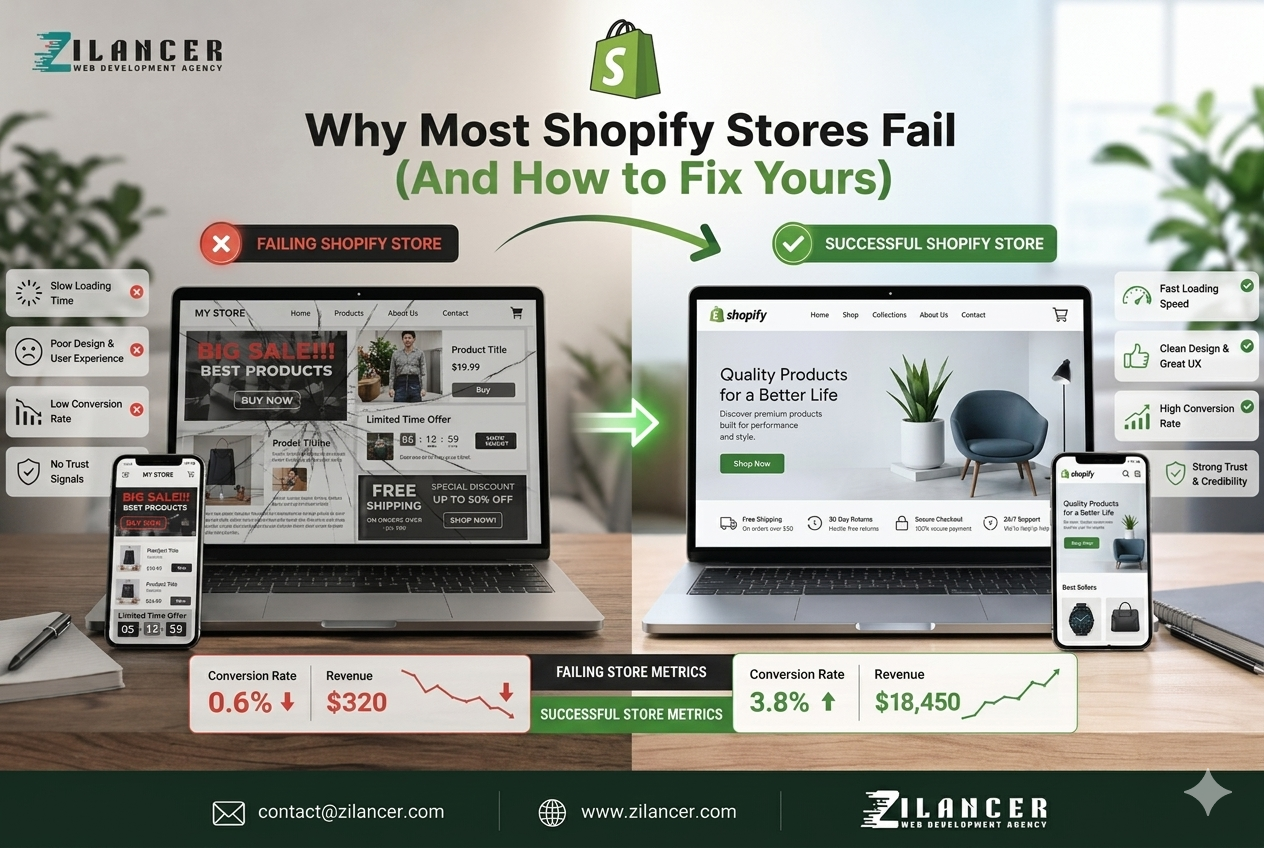
Most Shopify stores fail to generate revenue, not because the platform is flawed, but because the strategy behind the store is weak or incomplete. Many store owners focus heavily on launching quickly, choosing a theme, and uploading products, but overlook the critical elements that actually drive sales. A visually appealing store alone is not enough—without a clear conversion strategy, even high traffic will result in little to no revenue. One of the biggest reasons for failure is poor product-market fit. Many stores try to sell saturated or low-demand products without understanding their target audience. If the product doesn’t solve a real problem or stand out in the market, customers simply won’t buy, no matter how good the design looks. Along with that, weak branding and lack of trust signals—such as reviews, testimonials, and clear policies—make visitors hesitant to complete a purchase. Another major issue is bad user experience (UX). Slow loading speed, confusing navigation, and cluttered layouts can frustrate visitors and push them to leave the site within seconds. In today’s competitive market, users expect a smooth, fast, and mobile-friendly experience. If your store doesn’t deliver that, you lose potential customers before they even explore your products.
Ineffective product pages also play a critical role in poor performance. Many Shopify stores use generic descriptions, low-quality images, and fail to highlight the benefits of the product. A high-converting product page should clearly communicate value, answer customer objections, and create urgency. Without these elements, visitors may be interested but won’t feel confident enough to buy. Marketing mistakes are another common reason. Store owners often run ads without proper targeting, testing, or funnel strategy. Driving traffic without understanding customer behavior leads to wasted ad spend and low returns. Successful stores rely on data-driven marketing, retargeting, and continuous optimization to improve performance over time. Additionally, many stores lack a conversion funnel. They don’t capture leads, follow up with potential customers, or use email and retargeting strategies to bring visitors back. Most customers don’t buy on their first visit, so without a system in place to nurture them, businesses lose a large portion of potential revenue. Lastly, unrealistic expectations and a lack of consistency cause many store owners to quit too early. eCommerce success requires testing, learning, and improving continuously. Those who expect instant results often give up before their store has a chance to grow. In reality, Shopify stores don’t fail because of the platform—they fail because of a missing strategy, poor execution, and a lack of optimization. Businesses that focus on customer experience, strong branding, data-driven marketing, and continuous improvement are the ones that turn their stores into profitable, scalable revenue machines.
What Does a “Revenue Machine” Shopify Store Look Like?
A “Revenue Machine” Shopify store is not just a beautiful website—it’s a fully optimized system designed to consistently turn visitors into paying customers and maximize every opportunity for profit. Unlike average stores that rely on random traffic and hope for sales, a revenue-focused Shopify store is built with strategy, data, and performance at its core. First, it starts with a high-converting foundation. The design is clean, professional, and user-focused, guiding visitors smoothly from the landing page to checkout without confusion. Every element—colors, layout, buttons, and structure—is intentionally placed to improve user experience and drive action. The store loads fast across all devices, especially mobile, ensuring visitors don’t leave due to delays or frustration. A true revenue machine also features powerful product pages. Instead of generic descriptions, each product is presented with clear benefits, compelling copy, high-quality images, and persuasive elements like reviews, testimonials, and guarantees. These pages are designed to answer customer questions, remove doubts, and build trust instantly, increasing the likelihood of conversion. Another key component is a strong conversion funnel. The store doesn’t rely only on first-time visitors—it captures leads through pop-ups, offers, or discounts and follows up with email and retargeting campaigns. This ensures that even if visitors don’t buy immediately, they are brought back and converted later. Every step of the customer journey is optimized to maximize lifetime value, not just one-time purchases.
Data-driven decision-making is what truly separates a revenue machine from a regular store. Every action is tracked and analyzed—visitor behavior, click patterns, conversion rates—so continuous improvements can be made. A/B testing is regularly used to refine product pages, ads, and user flow, ensuring the store keeps improving over time. Marketing integration is also essential. A revenue machine Shopify store works seamlessly with paid ads, social media, SEO, and email marketing. Traffic is not random—it’s targeted, strategic, and aligned with the store’s ideal customer profile. Retargeting plays a big role in capturing lost opportunities and increasing overall ROI. Finally, a revenue machine is built for scalability. It can handle increasing traffic, expanding product lines, and growing customer demand without breaking performance. Automation tools, apps, and backend systems are integrated to streamline operations and support long-term growth. In simple terms, a “Revenue Machine” Shopify store is a combination of smart design, optimized performance, strategic marketing, and continuous improvement. It doesn’t just exist online—it actively works to generate consistent revenue, turning visitors into loyal customers and helping businesses scale efficiently.
How Zilancer Turns Shopify Stores Into Revenue Machines
A visually appealing website can grab attention, but design alone is not enough to drive real business results. Many Shopify store owners invest heavily in making their store look modern and attractive, yet still struggle to generate consistent sales. The truth is, design is only one piece of a much larger puzzle. Without strategy, performance, and optimization, even the most beautiful store can fail to convert visitors into customers. One of the main reasons design alone falls short is that it doesn’t address user intent and behavior. A website might look stunning, but if visitors can’t easily find what they’re looking for or don’t understand the value of the product, they will leave without taking action. Effective websites are built with a clear user journey in mind, guiding visitors step by step toward making a purchase.
Another critical factor is website speed and performance. A beautifully designed store that loads slowly will lose customers within seconds. Today’s users expect fast, seamless experiences across all devices, especially on mobile. If performance is poor, design becomes irrelevant because users won’t stay long enough to appreciate it. Design also doesn’t guarantee trust and credibility. Customers need reassurance before making a purchase—things like reviews, testimonials, clear return policies, and secure payment options play a huge role in building confidence. Without these elements, even the best design cannot overcome hesitation or doubt. Additionally, the conversion strategy is what truly drives revenue. This includes persuasive copywriting, strong calls-to-action, optimized product pages, and a frictionless checkout process. A well-designed page without these elements may look good, but won’t effectively convince visitors to buy.
Marketing integration is another missing piece when focusing only on design. Traffic must be targeted, and there needs to be a system in place to capture leads, retarget visitors, and nurture potential customers. Without this, businesses rely too heavily on first-time visitors, missing out on long-term growth opportunities. Finally, data and continuous optimization are essential for success. A static design cannot adapt to changing user behavior or market trends. High-performing stores constantly test, analyze, and improve based on real data to increase conversions and revenue over time. In reality, design should support performance—not replace it. A successful Shopify store combines attractive design with speed, strategy, trust-building elements, and data-driven optimization. When all these components work together, the store becomes more than just visually appealing—it becomes a powerful tool for generating consistent and scalable revenue. Turning your Shopify store into a revenue machine isn’t about luck—it’s about strategy, execution, and continuous improvement.
Most stores fail because they focus on the wrong things. But when you optimize the right elements, everything changes.