







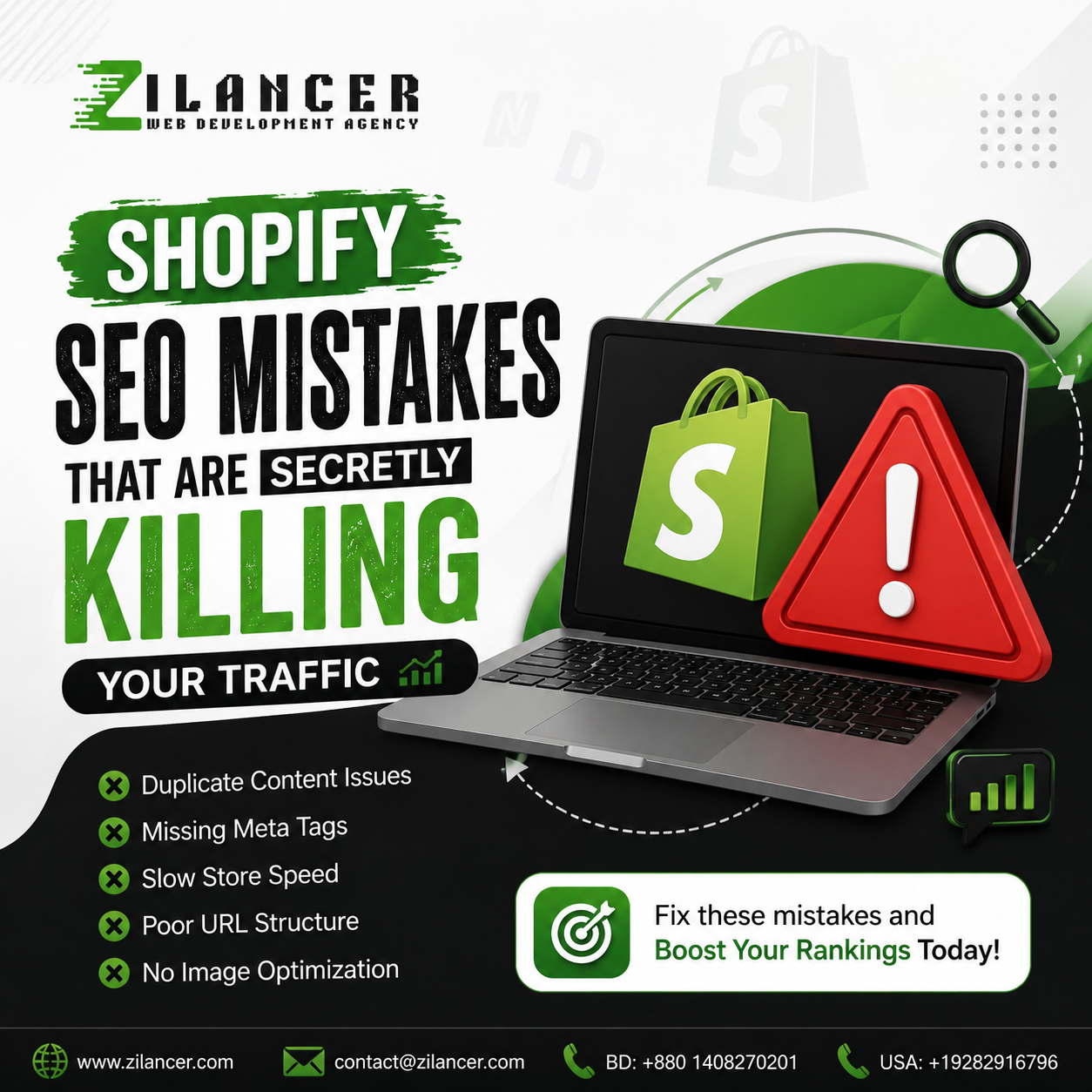
In today’s highly competitive eCommerce world, having a Shopify store is not enough. Thousands of stores are launched every single day, but only a small percentage of them ever achieve consistent organic traffic and long-term sales growth. The difference between a store that struggles and a store that scales often comes down to one critical factor: SEO. Search Engine Optimization is not just about adding keywords. It is about building a structured, fast, user-friendly, and search-optimized experience that helps Google understand your store and helps customers trust your brand. Unfortunately, many Shopify store owners unknowingly make serious SEO mistakes that silently destroy their organic traffic. In this detailed guide, we will break down the top Shopify SEO mistakes that are killing your traffic, explain why they matter, and show you how to fix them. We will also show how professional optimization from experts like Zilancer can transform your Shopify store into a high-performing sales machine.
Poor Site Structure That Confuses Search Engines
A poorly structured Shopify store is one of the most silent yet powerful reasons behind lost organic traffic. Many store owners focus heavily on design, products, and advertising, but completely ignore how their websites are organized behind the scenes. Search engines like Google do not “see” your store the way humans do; they rely on structure, hierarchy, and internal pathways to understand what your website is about and which pages are most important. When your Shopify store lacks a clear structure, search engines struggle to properly crawl and index your pages. This means your important product pages may not appear in search results, even if they are high quality. Instead of building authority across your website, your pages end up scattered, isolated, and disconnected from each other. This weakens your entire SEO foundation. A confusing structure also affects user behavior. When visitors cannot easily navigate through categories, subcategories, and product collections, they tend to leave quickly. High bounce rates and low session durations send negative signals to search engines, which further reduces your rankings over time. In simple terms, poor structure not only confuses Google but also frustrates your customers. In many Shopify stores, this issue occurs because products are added without first planning the hierarchy. Categories become random, collections overlap, and internal linking is either missing or inconsistent. Over time, the store becomes difficult to manage and even harder for search engines to interpret.
A properly structured Shopify store should be built like a logical roadmap. Every homepage should guide users into clear collections, every collection should support a defined product group, and every product should connect back to its category and related content. This creates a smooth flow of authority and relevance across the entire website. When structure is properly designed, search engines can easily understand which pages are most important, how content is related, and which keywords each section should rank for. This improves indexing efficiency and increases the chances of ranking for multiple search queries instead of just a few. At a professional level, agencies like Zilancer focus heavily on fixing structural SEO issues before anything else. Because without a strong structure, even the best content and design cannot perform to their full potential. A well-planned architecture becomes the foundation that supports everything else, from keyword rankings to conversions. Fixing site structure is not just an SEO improvement; it is a long-term investment in scalability. As your Shopify store grows, a clean structure allows you to add more products, categories, and content without breaking the system. It keeps everything organized, searchable, and optimized for both users and search engines.
Ignoring Keyword Research and Search Intent
Ignoring keyword research and search intent is one of the fastest ways to kill organic traffic on a Shopify store. Many store owners make the mistake of building their entire store around personal assumptions, trending products, or competitor inspiration without ever analyzing how real users actually search on Google. This leads to content that looks good on the surface but is completely invisible in search engines.Keyword research is not just about finding popular words. It is about understanding the exact language your customers use when they are ready to buy, compare, or learn about a product. Every search query has intent behind it, and search engines are designed to match that intent with the most relevant pages. If your Shopify store is not aligned with that intent, your pages will struggle to rank no matter how well designed they are. One of the most common issues in Shopify SEO is targeting keywords that are either too broad or completely irrelevant to the actual product pages. For example, new stores often try to rank for highly competitive terms while ignoring long-tail keywords that actually bring high-converting traffic. This results in wasted effort, low visibility, and poor return on SEO investment.
Search intent plays an even bigger role than keywords themselves. Two users may search similar phrases but expect completely different results. One might be looking for information, while another is ready to make a purchase. If your product page is targeting informational intent or your blog is targeting transactional intent incorrectly, Google will not consider your page a good match.Another major problem is ignoring the stage of the customer journey. A buyer does not always search with “buy now” intent. Sometimes they search to compare options, read reviews, or understand product benefits. A successful Shopify SEO strategy maps content to each stage of this journey so that every visitor finds exactly what they need at the right time.When keyword research and intent are ignored, the entire SEO strategy becomes random. You may get impressions, but not clicks. You may get traffic, but not conversions. This is because the content is not aligned with what users actually want, even if it contains the right words.
Proper keyword research builds the foundation for everything else in SEO, including content creation, product page optimization, blog strategy, and internal linking. It helps you understand not only what people are searching for, but also why they are searching for it. Without this understanding, even the most beautifully designed Shopify store will fail to attract consistent organic traffic.At a professional level, agencies like Zilancer treat keyword research as the backbone of every SEO campaign. Instead of guessing, they analyze real search data, competitor gaps, and buyer behavior patterns to build a strategy that targets the right audience at the right time. This ensures that every page on a Shopify store has a clear purpose and a strong chance of ranking.When keyword research and search intent are properly implemented, your Shopify store stops competing blindly and starts attracting highly relevant visitors who are already interested in what you offer. This is the difference between random traffic and profitable traffic that actually converts into sales.
Weak Product Descriptions That Fail to Rank
Weak product descriptions are one of the most overlooked yet damaging Shopify SEO mistakes that directly affect both search visibility and conversion rates. Many store owners either copy product content from suppliers or write extremely short descriptions that provide almost no real value to users or search engines. This creates a major gap in SEO performance because Google depends heavily on unique, relevant, and informative content to understand what a product page is about.When product descriptions are thin, duplicated, or generic, search engines struggle to differentiate your pages from thousands of similar stores. This results in low indexing priority and poor ranking potential. Even if your product is high quality, the lack of meaningful content makes it nearly invisible in organic search results. In competitive niches, this can completely eliminate your chances of ranking on the first page.A strong product description is not just a paragraph of text. It is a strategic piece of content that explains the product clearly, highlights its benefits, answers customer questions, and naturally integrates relevant keywords. It should guide the customer through a decision-making process rather than simply listing features. When done correctly, it improves both SEO performance and user trust at the same time.
Another critical issue with weak product content is the lack of uniqueness. Search engines penalize duplicate content because it adds no new value to the web. Many Shopify stores unknowingly use manufacturer descriptions that are repeated across multiple websites. This makes it extremely difficult for Google to decide which page deserves ranking priority, often resulting in none of them performing well.Product descriptions also play a major role in matching search intent. A user searching for a product is not just looking for a name; they want clarity, reassurance, and confidence before making a purchase. If your content fails to address their needs, they are more likely to leave your site and look for a competitor who provides better information. This increases bounce rate and reduces your overall SEO performance.High-quality product descriptions should be structured in a way that naturally guides the reader. They should explain what the product is, who it is for, what problem it solves, and why it is better than alternatives. This approach not only improves rankings but also increases conversions because customers feel more informed and confident.
Another important factor is keyword integration. Instead of forcing keywords unnaturally, they should be included in a way that feels organic within the flow of the content. Over-optimization can be just as harmful as under-optimization. The goal is to create human-readable content that also communicates relevance to search engines.At a professional level, agencies like Zilancer focus heavily on rewriting and optimizing product content as part of a complete Shopify SEO strategy. They ensure that every product page is not just a listing, but a fully optimized landing page designed to rank in search engines and convert visitors into buyers.When product descriptions are improved with proper SEO structure, unique messaging, and intent-driven writing, they become powerful ranking assets. Instead of being ignored by search engines, they start attracting consistent organic traffic and contributing directly to store growth.
Missing or Weak Technical SEO Setup
A missing or weak technical SEO setup is one of the most dangerous Shopify SEO problems because it often stays completely invisible while silently blocking your entire store from reaching its full ranking potential. Many store owners assume that if their website looks good and products are uploaded, SEO will automatically work. In reality, search engines depend heavily on technical signals to properly crawl, interpret, and rank your Shopify store. Technical SEO is the foundation layer that supports everything else in your website. Without it, even high-quality content, strong product pages, and proper keywords cannot perform effectively. Search engines first need to understand your site structure, indexing rules, metadata, and performance signals before they decide where your pages should appear in search results. One of the most common technical issues in Shopify stores is improper indexing configuration. Sometimes important pages are accidentally blocked from being indexed, while low-value pages get indexed instead. This creates confusion for search engines and reduces your chances of ranking for important keywords. When Google cannot clearly determine which pages should be prioritized, your overall domain authority becomes diluted. Another major issue is duplicate content caused by URL parameters, collection filters, and product variations. Shopify stores often generate multiple URLs for similar or identical content, which confuses search engines and splits ranking signals across multiple pages. Instead of one strong page ranking higher, you end up with several weak pages competing against each other.
Meta tags and structured data are also frequently missing or poorly optimized. Title tags and meta descriptions are not just simple labels; they are critical ranking and click-through signals. When they are missing or duplicated, search engines struggle to understand the relevance of each page. Structured data, on the other hand, helps Google interpret your products, prices, reviews, and availability in a more meaningful way. Without it, your store misses out on rich search results that can significantly improve visibility. Site speed and performance are another core part of technical SEO. Many Shopify stores become slow due to heavy themes, unoptimized images, and unnecessary third-party apps. Slow-loading websites not only frustrate users but also reduce search rankings because page experience is now a confirmed ranking factor. Even a small delay in loading time can significantly impact both traffic and conversions. Crawlability is another often-ignored factor. If search engine bots cannot efficiently navigate your website, they will not index all your pages properly. Poor internal linking, broken links, and poorly structured navigation can all reduce crawl efficiency. This means some of your important pages may never be discovered or updated in search results.
At a deeper level, technical SEO also includes XML sitemaps, canonical tags, robots.txt configuration, and mobile optimization. Each of these elements plays a critical role in helping search engines understand how your website should be treated. When any of these are misconfigured, it can lead to ranking drops, indexing issues, or even complete visibility loss for certain pages.At a professional level, agencies like Zilancer specialize in identifying and fixing these hidden technical issues. Instead of relying on surface-level optimization, they perform deep audits to ensure that every technical element of a Shopify store is correctly configured for maximum search performance. When technical SEO is properly implemented, your Shopify store becomes easier for search engines to crawl, understand, and rank. It creates a strong foundation that supports all other SEO efforts and ensures that your store is fully optimized for long-term organic growth.
No Blogging Strategy for Organic Growth
Not having a blogging strategy is one of the most underestimated Shopify SEO mistakes that quietly limits long-term organic growth. Many store owners treat their website as only a product catalog, assuming that traffic will come only from product pages. In reality, search engines reward websites that consistently publish helpful, relevant, and structured content that answers user questions across different stages of the buying journey.A Shopify store without a blog is like a shop with no entrance sign. Your products may be excellent, but without informational content that attracts new users, your store depends entirely on paid ads or brand searches. This creates a growth ceiling where traffic stops scaling naturally over time. Blog content plays a critical role in capturing informational search intent. Most users do not start their journey by searching for a product name. Instead, they search for problems, comparisons, guides, and solutions. If your store does not have blog content targeting these queries, you lose the opportunity to bring these users into your ecosystem early.Another major issue is missing topical authority. Search engines evaluate how well a website covers a specific niche. When your Shopify store only has product pages, it signals limited depth of knowledge. However, when you consistently publish high-quality blog content around your niche, you build authority and trust in the eyes of search engines. This directly improves rankings for both blog posts and product pages.Blogs also play a powerful role in internal linking. Without content pages, there are fewer opportunities to connect your product pages in a meaningful and strategic way. Internal links help distribute authority across your website and guide both users and search engines toward important pages. When this structure is missing, your SEO strength becomes uneven and fragmented.
Another problem caused by no blogging strategy is missed keyword opportunities. Product pages are usually focused on transactional keywords, but blogs allow you to target long-tail keywords, informational queries, and comparison-based searches. These keywords often have lower competition and higher conversion potential because users are still in the decision-making stage.A strong blog strategy also improves customer trust. When users find helpful articles on your website, they perceive your brand as more authoritative and reliable. This increases the likelihood of returning visitors and repeat engagement, which indirectly improves SEO performance through better user signals.At a technical level, blog content also helps increase crawl frequency. Search engines revisit websites more often when they detect fresh and updated content. This means new products and pages get indexed faster when a blog is actively maintained.At a professional level, agencies like Zilancer integrate blogging as a core part of Shopify SEO strategy. Instead of treating blogs as optional content, they build structured content systems that target buyer intent, improve internal linking, and strengthen overall domain authority.
When a proper blogging strategy is implemented, your Shopify store stops relying only on direct product traffic and starts building a sustainable organic traffic engine. Over time, this leads to consistent visibility, stronger rankings, and higher conversion opportunities across your entire store.
How Zilancer Helps You Fix Shopify SEO Problems
Fixing Shopify SEO problems is not about applying random tips or installing a few apps. It requires a complete understanding of how search engines interpret your website, how users behave on your store, and how technical, content, and structural elements work together to influence rankings. Most Shopify stores fail not because SEO is impossible, but because it is handled in a fragmented and inconsistent way.This is where a structured, expert-driven approach becomes essential. At this stage, working with a specialized team like Zilancer can completely change how your store performs in search results. Instead of focusing on surface-level fixes, the approach is centered on building a strong SEO foundation that supports long-term organic growth. The first step in solving Shopify SEO issues is identifying what is actually broken behind the scenes. Many store owners only see traffic drops or low rankings, but they do not understand the root cause. It could be technical errors, weak site structure, poor keyword targeting, slow performance, or thin content. A proper SEO process begins with a deep audit that uncovers these hidden issues and prioritizes what needs to be fixed first. Once the problems are identified, the next step is restructuring the website in a way that makes sense for both users and search engines. This includes improving navigation flow, organizing collections properly, and ensuring that every product page is placed within a logical hierarchy. A strong structure ensures that authority flows correctly across the entire website and no important page is left isolated. Content optimization is another major area where most Shopify stores struggle. Many product pages are either too short, duplicated, or not aligned with search intent. A professional SEO approach involves rewriting and optimizing content so that it not only includes relevant keywords but also answers real customer questions. This helps search engines understand relevance while also improving conversion rates. Technical SEO improvements are equally important. This includes fixing indexing issues, optimizing site speed, resolving duplicate URLs, improving mobile performance, and ensuring that structured data is properly implemented. Without these technical improvements, even the best content will struggle to rank consistently.
Keyword research and search intent mapping also play a central role in the process. Instead of guessing what users might search for, a data-driven approach identifies exactly what potential customers are typing into search engines and how competitive those terms are. This allows the store to target high-value keywords that bring qualified traffic rather than random visitors.Another key focus is performance optimization. A slow Shopify store not only loses customers but also ranks lower in search engines. Improving load speed, optimizing images, and reducing unnecessary scripts creates a smoother experience that benefits both SEO and user satisfaction.At every stage of this process, the goal is not just to increase traffic but to increase the right kind of traffic that converts into real sales. That is why SEO is treated as a business growth system rather than just a marketing task.By working with Zilancer, Shopify store owners get a structured and strategic approach that removes guesswork from SEO. Instead of relying on trial and error, every decision is backed by analysis, experience, and performance-focused execution.When Shopify SEO problems are fixed properly, the result is not just better rankings, but a stronger digital foundation that continuously brings organic traffic, improves brand visibility, and increases long-term revenue potential.
Shopify SEO mistakes can silently destroy your traffic without you even realizing it. From poor site structure and weak product descriptions to slow loading speed and missing technical SEO, every small issue adds up and reduces your visibility on search engines. The good news is that all these problems are fixable. With the right strategy, proper optimization, and expert support, any Shopify store can improve rankings and increase organic traffic significantly.
If you are serious about growing your Shopify business and want to avoid these costly mistakes, working with experts like Zilancer can be a game-changing decision for your eCommerce success.