







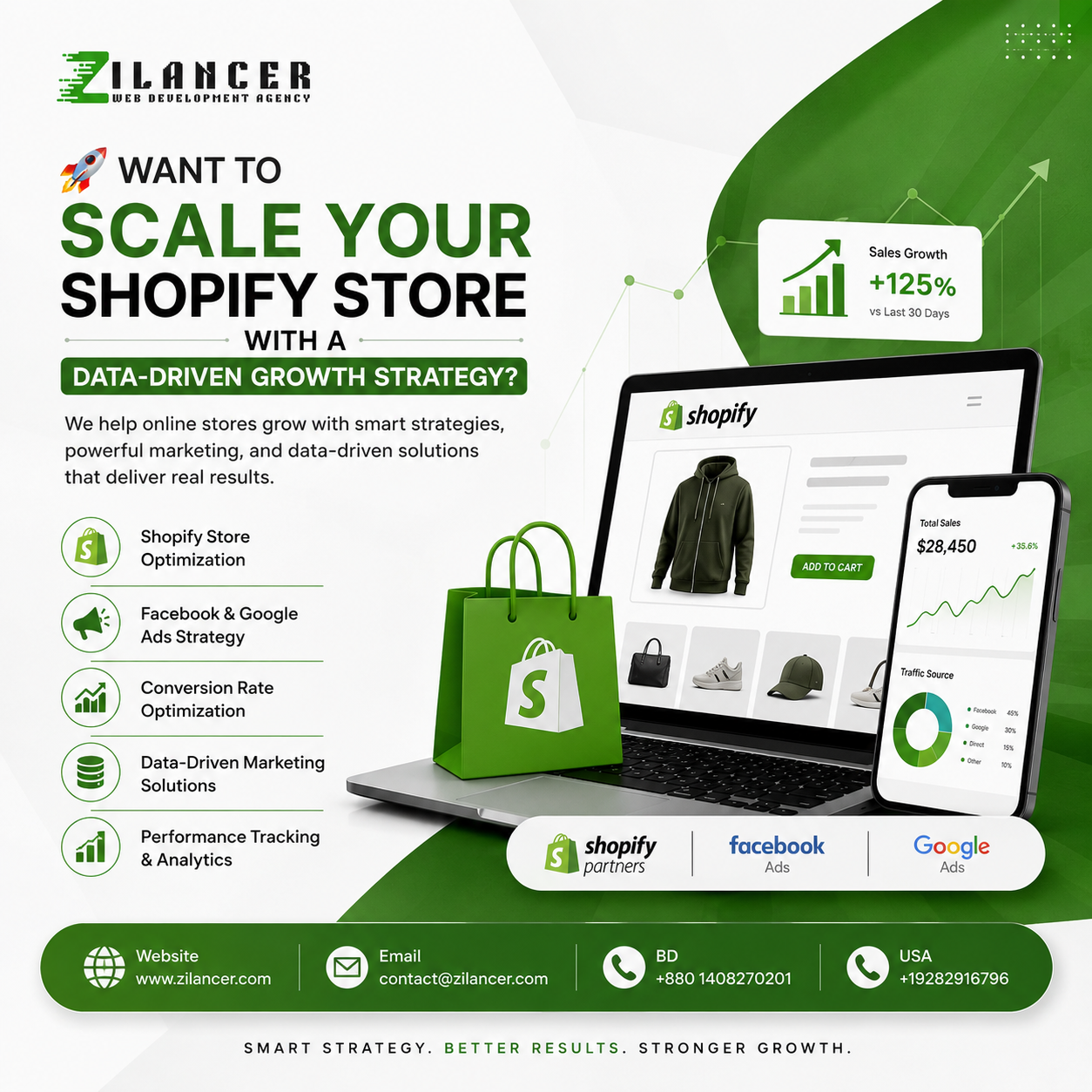
The eCommerce industry has become more competitive than ever before. Every day, thousands of online stores compete for customer attention, making it increasingly difficult for brands to stand out and achieve sustainable growth. While many businesses continue to rely on assumptions, intuition, and outdated marketing tactics, successful Shopify brands are embracing a different approach. They are using data-driven growth strategies to make smarter decisions, improve customer experiences, increase conversions, and maximize profitability. A data-driven Shopify growth strategy focuses on collecting, analyzing, and utilizing customer and business data to make informed decisions. Instead of guessing what customers want, store owners can identify actual customer behavior patterns, understand purchasing journeys, optimize user experiences, and create highly targeted marketing campaigns that generate measurable results.
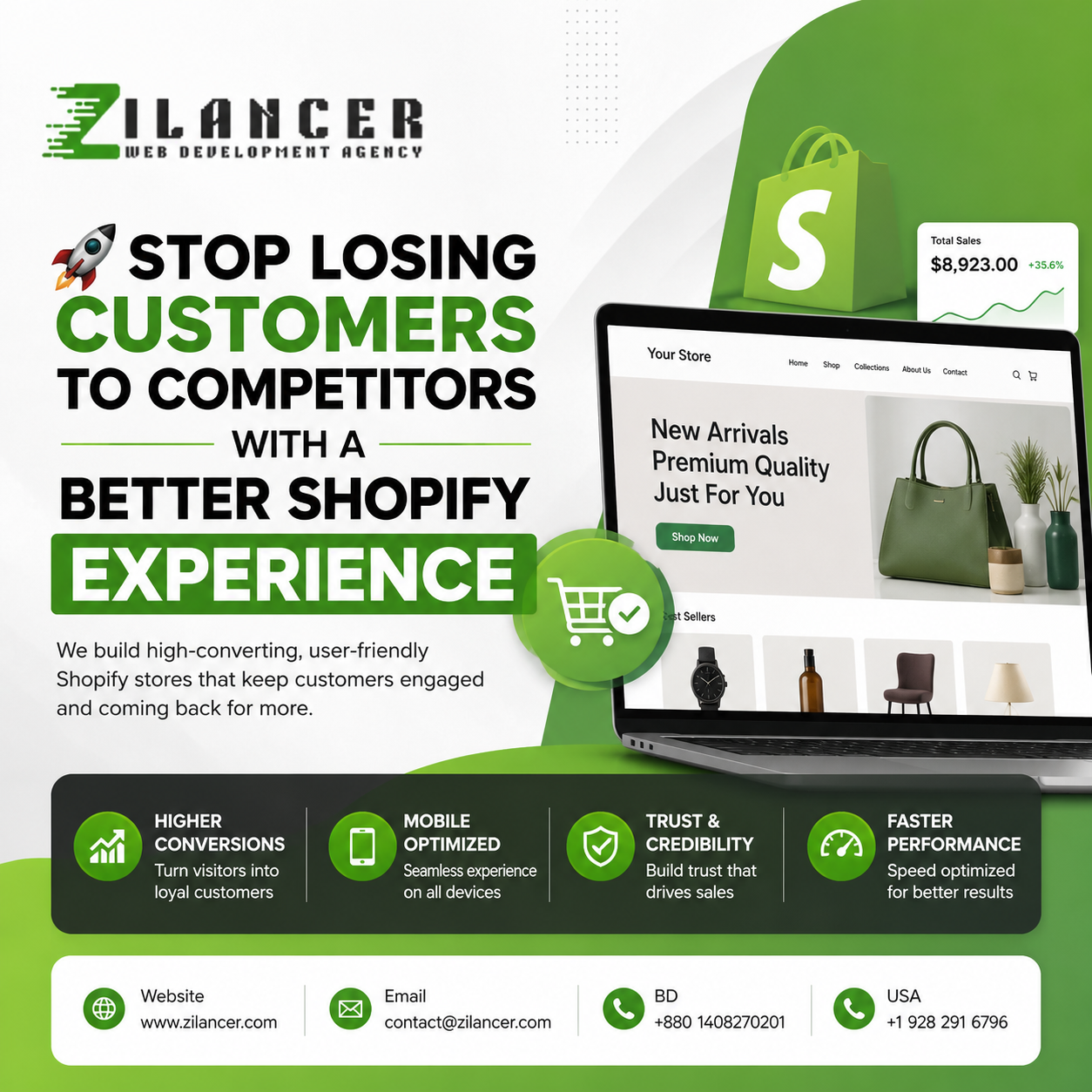
At the center of this transformation is Zilancer, a certified Shopify-focused agency dedicated to helping brands build, optimize, and scale high-performing Shopify stores. Through advanced analytics, conversion rate optimization, Shopify development, UX improvements, and performance-focused design, Zilancer helps businesses unlock new levels of growth and profitability. According to information published on the Zilancer website, the agency specializes in Shopify development, custom themes, speed optimization, migrations, integrations, conversion optimization, SEO, and long-term Shopify growth solutions.
Why Data Matters More Than Ever in Shopify eCommerce
The Shopify eCommerce landscape has evolved dramatically over the past few years. With thousands of new online stores launching every day, competition is no longer limited to local businesses or niche competitors. Today, Shopify merchants compete in a global marketplace where customer expectations are higher than ever, and purchasing decisions are influenced by countless factors. In this highly competitive environment, relying on assumptions or intuition is no longer enough. Businesses need accurate, actionable insights to make informed decisions, and that is exactly where data becomes one of the most valuable assets for any Shopify store. Modern consumers generate enormous amounts of data throughout their online shopping journey. Every website visit, product view, search query, add-to-cart action, checkout attempt, and completed purchase provides valuable information about customer behavior. This data reveals what customers are interested in, how they interact with a store, where they encounter friction, and what ultimately influences their buying decisions. For Shopify store owners, these insights create opportunities to improve user experience, optimize marketing campaigns, and increase overall revenue. One of the biggest advantages of data-driven decision-making is the ability to eliminate guesswork. Many online businesses invest significant amounts of money into advertising, website redesigns, and promotional campaigns without fully understanding what is actually driving results. Data provides clarity by identifying which traffic sources generate the most qualified visitors, which products perform best, and which marketing efforts produce the highest return on investment. Instead of making decisions based on opinions or trends, businesses can rely on measurable evidence to guide their growth strategies. Customer behavior analysis has become especially important in today’s Shopify ecosystem. Understanding how visitors navigate through a website allows merchants to identify areas where users lose interest or abandon the buying process. For example, analytics can reveal whether customers are leaving product pages too quickly, abandoning carts at checkout, or failing to engage with specific content sections. These insights help businesses make targeted improvements that enhance customer experience and increase conversion rates.
Data also plays a critical role in personalizing the shopping experience. Modern consumers expect brands to understand their preferences and provide relevant recommendations. By analyzing customer data, Shopify stores can create personalized product suggestions, targeted email campaigns, customized promotions, and tailored shopping experiences that resonate with individual customers. Personalization not only improves customer satisfaction but also increases average order value, repeat purchases, and long-term customer loyalty. Another reason data matters more than ever is the growing complexity of digital marketing. Shopify merchants often use multiple marketing channels, including search engine optimization, paid advertising, social media marketing, influencer partnerships, email campaigns, and content marketing. Without proper data tracking, it becomes difficult to determine which channels contribute most effectively to business growth. Advanced analytics allow merchants to measure performance across all channels, identify profitable customer acquisition sources, and allocate budgets more efficiently. Data-driven strategies are also essential for improving conversion rates. Increasing website traffic is important, but maximizing the value of existing traffic often produces greater returns. Through analytics and testing, businesses can identify conversion barriers and optimize critical elements such as landing pages, product descriptions, pricing strategies, trust signals, and checkout processes. Even small improvements in conversion rates can have a significant impact on overall revenue and profitability. As mobile commerce continues to grow, data becomes increasingly important for understanding device-specific user behavior. Shopify merchants can analyze how mobile users interact with their stores compared to desktop visitors. This information helps businesses optimize mobile experiences, improve page speed, simplify navigation, and create seamless purchasing journeys across all devices. Since a large percentage of online shopping now takes place on smartphones, these insights are critical for long-term success.
Customer retention is another area where data delivers substantial value. Acquiring new customers is often more expensive than retaining existing ones. By analyzing purchase history, customer lifetime value, and engagement patterns, Shopify businesses can develop effective retention strategies that encourage repeat purchases and strengthen customer relationships. Data helps identify high-value customers, predict future buying behavior, and create loyalty programs that maximize long-term revenue. The rise of artificial intelligence and automation has further increased the importance of data in eCommerce. AI-powered tools rely on accurate customer data to generate recommendations, automate marketing activities, forecast inventory needs, and optimize business operations. Stores that maintain clean, organized, and actionable data are better positioned to leverage emerging technologies and gain a competitive advantage in the marketplace.
At Zilancer, data-driven decision-making is a core part of every Shopify growth strategy. Rather than relying on assumptions, the team focuses on analyzing performance metrics, customer behavior, conversion patterns, and user experience data to develop solutions that generate measurable results. By combining analytics, Shopify expertise, conversion optimization, and strategic planning, Zilancer helps online businesses make smarter decisions, improve store performance, and achieve sustainable long-term growth. As the eCommerce industry becomes increasingly competitive, data is no longer just a reporting tool—it is a strategic asset that influences every aspect of business success. Shopify merchants who embrace data-driven growth strategies gain deeper insights into customer behavior, make better business decisions, improve marketing efficiency, and create superior shopping experiences. In a market where every interaction matters, leveraging data effectively can be the difference between stagnant growth and long-term eCommerce success.
Understanding the Foundations of Data-Driven Growth
In today’s highly competitive eCommerce environment, sustainable business growth requires more than creative marketing campaigns and attractive website designs. Successful Shopify brands are increasingly relying on data to guide every aspect of their decision-making process. Data-driven growth is the practice of collecting, analyzing, and applying business intelligence to improve performance, optimize customer experiences, and increase revenue. Understanding the foundations of this approach is essential for any Shopify store looking to achieve long-term success in a rapidly evolving digital marketplace. At its core, data-driven growth begins with accurate data collection. Every interaction that takes place on a Shopify store generates valuable information. From the moment a visitor lands on a website to the point of purchase and beyond, each action provides insights into customer behavior, preferences, and buying intent. Businesses that effectively capture and analyze this information gain a deeper understanding of how their stores perform and where opportunities for improvement exist.
The first foundation of data-driven growth is establishing clear business objectives. Before analyzing metrics, Shopify merchants must define what success looks like for their business. Some stores may focus on increasing conversion rates, while others prioritize customer retention, average order value, or overall revenue growth. Having clearly defined goals helps businesses identify which data points are most relevant and ensures that analytics efforts remain aligned with broader business objectives. Another critical foundation is understanding key performance indicators. These metrics provide measurable insights into store performance and help businesses evaluate progress toward their goals. Important Shopify metrics often include conversion rates, customer acquisition costs, customer lifetime value, average order value, cart abandonment rates, revenue per visitor, and repeat purchase rates. By consistently monitoring these indicators, merchants can identify trends, uncover opportunities, and make informed decisions based on actual performance data rather than assumptions. Customer behavior analysis forms another essential pillar of data-driven growth. Every visitor follows a unique journey through an online store. Understanding how customers interact with different pages, products, and content sections helps businesses optimize the shopping experience. Behavioral insights reveal where visitors spend the most time, which products attract the most attention, and where users encounter obstacles that prevent conversions. This information allows merchants to improve navigation, simplify purchasing processes, and create more engaging customer experiences.
Data accuracy and consistency are equally important foundations. Inaccurate or incomplete data can lead to poor decision-making and ineffective growth strategies. Shopify businesses should ensure that analytics tools are properly configured, tracking systems are functioning correctly, and reporting processes are regularly reviewed. Reliable data creates confidence in business decisions and enables merchants to identify opportunities with greater precision. Segmentation is another key component of a successful data-driven strategy. Not all customers behave in the same way, and treating every visitor as a single audience often limits growth potential. By segmenting customers based on demographics, purchasing behavior, traffic sources, geographic location, and engagement levels, businesses can create more personalized experiences. Customer segmentation helps merchants deliver relevant marketing messages, product recommendations, and promotional offers that resonate with specific audience groups and improve overall performance. A strong foundation for data-driven growth also requires a commitment to continuous testing and optimization. Successful Shopify brands understand that growth is an ongoing process rather than a one-time project. Through A/B testing, performance analysis, and customer feedback, businesses can continuously refine website elements, marketing campaigns, pricing strategies, and conversion funnels. Small improvements made consistently over time often generate substantial long-term results. Technology plays a significant role in supporting data-driven growth initiatives. Modern Shopify stores have access to powerful analytics platforms, customer relationship management systems, heat mapping tools, marketing automation software, and business intelligence solutions. These technologies help businesses collect, organize, and interpret large volumes of data more effectively. When integrated properly, they provide a comprehensive view of customer journeys and business performance, enabling smarter strategic decisions.
Predictive analytics is becoming an increasingly important aspect of data-driven growth. Instead of simply analyzing past performance, businesses can use data to forecast future trends and customer behavior. Predictive models help merchants anticipate demand, identify high-value customers, optimize inventory management, and create proactive marketing strategies. This forward-looking approach enables businesses to stay ahead of market changes and maintain a competitive advantage. For Shopify businesses seeking scalable growth, understanding customer lifetime value is particularly important. Rather than focusing exclusively on acquiring new customers, data-driven brands evaluate the long-term value each customer brings to the business. This perspective helps merchants invest more effectively in customer acquisition, retention strategies, loyalty programs, and personalized experiences that maximize profitability over time.
At Zilancer, the foundations of data-driven growth are integrated into every Shopify project. The agency understands that successful eCommerce growth requires more than technical development or visual design. By combining analytics, user experience optimization, conversion rate improvement, customer behavior analysis, and performance monitoring, Zilancer helps Shopify merchants build stronger foundations for sustainable business success. Every recommendation is guided by measurable insights, ensuring that data rather than assumptions back growth strategies.
As eCommerce continues to evolve, businesses that understand and embrace the foundations of data-driven growth will be better equipped to adapt, compete, and scale. Accurate data collection, meaningful analysis, customer understanding, continuous optimization, and strategic decision-making form the building blocks of long-term Shopify success. By establishing these foundations early, merchants can create a powerful framework that supports consistent growth, improved profitability, and stronger customer relationships in the years ahead.
Conversion Rate Optimization Through Data
Driving traffic to a Shopify store is only one part of the growth equation. While attracting visitors is essential, the true measure of eCommerce success lies in how effectively those visitors are converted into paying customers. This is where Conversion Rate Optimization (CRO) becomes a critical component of a data-driven Shopify growth strategy. Rather than focusing solely on increasing traffic, CRO aims to maximize the value of existing visitors by improving the percentage of users who complete desired actions, such as making a purchase, subscribing to an email list, or engaging with a brand. When powered by accurate data, conversion optimization becomes one of the most effective ways to increase revenue and profitability without significantly increasing marketing expenses. Data-driven conversion rate optimization begins with understanding how visitors interact with a Shopify store. Every customer journey generates valuable information that can reveal opportunities for improvement. By analyzing user behavior, merchants can identify which pages perform well, where customers encounter friction, and which elements influence purchasing decisions. This information provides a clear roadmap for making strategic improvements that enhance the overall shopping experience and encourage more conversions.
One of the most important aspects of conversion optimization is identifying bottlenecks within the sales funnel. Many Shopify stores experience significant visitor drop-offs between key stages of the buying process. Customers may leave after viewing a product page, abandon their shopping carts, or exit during checkout. Data helps uncover these problem areas by highlighting exactly where users are leaving the website. Once these friction points are identified, businesses can implement targeted improvements that reduce abandonment and increase completed purchases. Product pages are often among the most influential elements in a Shopify store’s conversion strategy. Data analysis can reveal which product pages generate the highest engagement and which struggle to convert visitors. Metrics such as time on page, scroll depth, click-through rates, and add-to-cart actions provide insights into customer behavior. By understanding how users interact with product content, merchants can improve product descriptions, optimize images, enhance trust signals, and create more persuasive purchasing experiences. User experience plays a major role in conversion performance. Modern consumers expect fast-loading websites, intuitive navigation, and seamless shopping experiences across all devices. Data-driven CRO allows businesses to evaluate how visitors interact with their store and identify usability issues that may hinder conversions. Slow page speeds, confusing navigation structures, poor mobile experiences, and complicated checkout processes can all negatively impact conversion rates. By addressing these issues through continuous analysis and optimization, Shopify stores can create smoother customer journeys that encourage purchases.
A/B testing is one of the most powerful tools within data-driven conversion optimization. Instead of relying on assumptions about what might improve performance, businesses can test different variations of website elements and measure actual results. Headlines, product images, call-to-action buttons, pricing displays, promotional messages, page layouts, and checkout designs can all be tested to determine which versions generate the highest conversion rates. This scientific approach to optimization helps merchants make decisions based on real customer behavior rather than opinions or industry trends. Customer trust is another crucial factor that influences conversion rates. Data often reveals that visitors hesitate to purchase when they lack confidence in a brand or product. Trust signals such as customer reviews, testimonials, secure payment badges, clear return policies, and transparent shipping information can significantly impact purchasing decisions. By analyzing customer behavior and feedback, businesses can identify trust gaps and implement improvements that increase buyer confidence and encourage conversions. Mobile commerce continues to dominate the eCommerce landscape, making mobile optimization a critical aspect of conversion rate optimization. Data frequently shows differences in conversion performance between desktop and mobile users. Mobile visitors may experience unique challenges related to navigation, form completion, page speed, or checkout usability. By analyzing device-specific performance metrics, Shopify merchants can optimize mobile experiences and ensure that customers enjoy a seamless purchasing journey regardless of the device they use.
Personalization is becoming increasingly important in modern conversion strategies. Customers are more likely to engage with content and offers that align with their interests and preferences. Data enables Shopify stores to segment audiences based on browsing behavior, purchase history, demographics, and engagement patterns. These insights allow businesses to deliver personalized product recommendations, targeted promotions, and customized shopping experiences that increase relevance and improve conversion rates. Cart abandonment remains one of the biggest challenges facing Shopify merchants. Many customers add products to their carts but leave before completing their purchase. Data-driven analysis helps identify the reasons behind abandonment, whether they involve unexpected shipping costs, complicated checkout processes, lack of payment options, or trust concerns. Understanding these factors allows businesses to implement solutions that reduce abandonment and recover potentially lost revenue. Conversion optimization also extends beyond the initial purchase. Data can help businesses identify opportunities to increase average order value through strategic upselling, cross-selling, and personalized product recommendations. By analyzing purchasing patterns and customer preferences, Shopify stores can present relevant offers that encourage larger transactions while enhancing the overall shopping experience. Another advantage of data-driven CRO is its ability to improve marketing efficiency. Many businesses spend substantial amounts on advertising campaigns without fully understanding how visitors behave after arriving on their website. Conversion data bridges the gap between marketing efforts and business outcomes by revealing which traffic sources generate the highest-quality visitors and the best conversion rates. This information allows merchants to allocate budgets more effectively and focus on campaigns that deliver measurable results.
At Zilancer, conversion rate optimization is an essential part of every Shopify growth strategy. The agency understands that increasing traffic alone is not enough to achieve sustainable growth. By analyzing customer behavior, evaluating performance metrics, identifying conversion barriers, and implementing data-backed improvements, Zilancer helps Shopify merchants maximize the value of every visitor. Through a combination of user experience optimization, performance enhancements, strategic design improvements, and ongoing testing, businesses can achieve significant gains in conversion rates and overall revenue. As competition in eCommerce continues to intensify, conversion rate optimization through data has become a necessity rather than an option. Businesses that leverage analytics to understand customer behavior and continuously improve their websites gain a significant competitive advantage. By focusing on measurable insights, eliminating friction, enhancing user experiences, and making informed decisions, Shopify merchants can transform more visitors into customers and build a stronger foundation for long-term growth and profitability.
How Zilancer Helps Shopify Brands Scale
Scaling a Shopify business requires much more than launching a beautiful online store. As competition in the eCommerce industry continues to grow, brands must focus on customer experience, website performance, conversion optimization, data-driven decision-making, and long-term growth strategies. Many store owners struggle to balance these critical areas while managing daily business operations. This is where Zilancer steps in as a trusted Shopify growth partner, helping businesses transform their stores into scalable, high-performing eCommerce brands. Zilancer is a Shopify-focused agency dedicated to helping online businesses achieve sustainable growth through strategic development, optimization, and performance-driven solutions. Rather than applying generic approaches, the team works closely with each client to understand their goals, target audience, competitive landscape, and growth challenges. This personalized approach allows Zilancer to develop tailored Shopify solutions that generate measurable business results and support long-term success.
One of the key ways Zilancer helps Shopify brands scale is through custom Shopify development. Every successful online store requires a strong technical foundation capable of supporting growth. Generic themes and poorly optimized websites often create limitations that affect performance, user experience, and conversion rates. Zilancer develops custom Shopify solutions designed to align with a brand’s unique identity while ensuring flexibility, scalability, and long-term functionality. Whether a business is launching a new store or upgrading an existing one, the agency focuses on creating robust eCommerce experiences that support future expansion. User experience plays a critical role in eCommerce success, and Zilancer places a strong emphasis on creating seamless customer journeys. A well-designed Shopify store should not only look professional but also guide visitors naturally toward making a purchase. Through detailed user experience analysis, customer journey optimization, and interface improvements, Zilancer helps businesses create websites that are intuitive, engaging, and conversion-focused. Every design decision is made with the customer in mind, resulting in better engagement, stronger trust, and higher conversion rates.
Conversion rate optimization is another area where Zilancer delivers significant value. Many Shopify stores generate traffic but fail to convert visitors into customers at their full potential. Rather than simply focusing on increasing traffic, the agency analyzes customer behavior, identifies friction points, and implements strategic improvements that increase conversion efficiency. By optimizing product pages, improving navigation, enhancing trust signals, refining checkout experiences, and testing performance elements, Zilancer helps brands maximize revenue from their existing audience. Website performance and speed optimization are essential components of scalable eCommerce growth. Research consistently shows that slow-loading websites negatively impact user experience, search engine rankings, and conversion rates. Zilancer prioritizes performance optimization by improving page speed, reducing unnecessary code, optimizing assets, and enhancing overall website responsiveness. These improvements help create faster, smoother shopping experiences that keep customers engaged and increase the likelihood of completed purchases.
Data-driven growth strategies are at the heart of Zilancer’s approach. Successful scaling requires more than intuition; it requires understanding how customers interact with a store and using that information to make smarter business decisions. Zilancer leverages analytics, customer behavior insights, conversion data, and performance metrics to identify growth opportunities and develop effective strategies. By transforming complex data into actionable insights, the agency helps Shopify merchants make informed decisions that drive sustainable growth. Search engine optimization is another important factor in long-term Shopify success. Organic traffic remains one of the most valuable and cost-effective customer acquisition channels available to eCommerce businesses. Zilancer helps brands improve their search visibility through technical SEO enhancements, on-page optimization, content strategy recommendations, site structure improvements, and performance-focused SEO implementation. By strengthening a store’s organic presence, businesses can attract qualified traffic and reduce their reliance on paid advertising over time.
As businesses grow, many encounter challenges related to platform migrations, custom integrations, and advanced functionality requirements. Zilancer provides expert Shopify migration services that ensure smooth transitions from platforms such as WooCommerce, Magento, BigCommerce, and others. The agency also develops custom integrations that connect Shopify stores with third-party systems, automation tools, inventory management platforms, customer relationship management software, and marketing technologies. These integrations streamline operations and create a more efficient business infrastructure capable of supporting growth at scale. Brand consistency and professional presentation are also critical for scaling an eCommerce business. Customers are more likely to trust and purchase from brands that present a cohesive and polished image. Zilancer works with businesses to create visually compelling Shopify experiences that reflect brand identity while maintaining a strong focus on usability and performance. The result is a store that not only attracts visitors but also builds credibility and encourages customer loyalty.
Another reason Shopify merchants choose Zilancer is the agency’s commitment to long-term partnerships. Scaling a business is an ongoing process that requires continuous optimization, testing, and adaptation. Rather than delivering a project and moving on, Zilancer supports clients through every stage of growth. By monitoring performance, identifying new opportunities, implementing improvements, and adapting strategies based on changing market conditions, the agency helps brands remain competitive in an evolving eCommerce landscape. The Shopify ecosystem continues to evolve with new technologies, consumer behaviors, and market trends emerging every year. Zilancer stays ahead of these changes by continuously refining its strategies and leveraging the latest Shopify capabilities. This proactive approach ensures that clients benefit from modern solutions that enhance customer experiences, improve operational efficiency, and support future growth.
Ultimately, Zilancer helps Shopify brands scale by combining technical expertise, strategic thinking, data-driven decision-making, and a deep understanding of eCommerce best practices. From custom development and conversion optimization to SEO, performance improvements, user experience design, and ongoing growth support, every service is designed with one objective in mind: helping businesses achieve sustainable, measurable, and profitable growth. For Shopify merchants seeking a reliable partner to accelerate their growth journey, Zilancer provides the expertise, innovation, and strategic guidance needed to turn ambitious goals into measurable business success. By focusing on performance, scalability, and customer-centric solutions, Zilancer empowers brands to build stronger online stores, reach more customers, and achieve lasting success in the competitive world of eCommerce.