







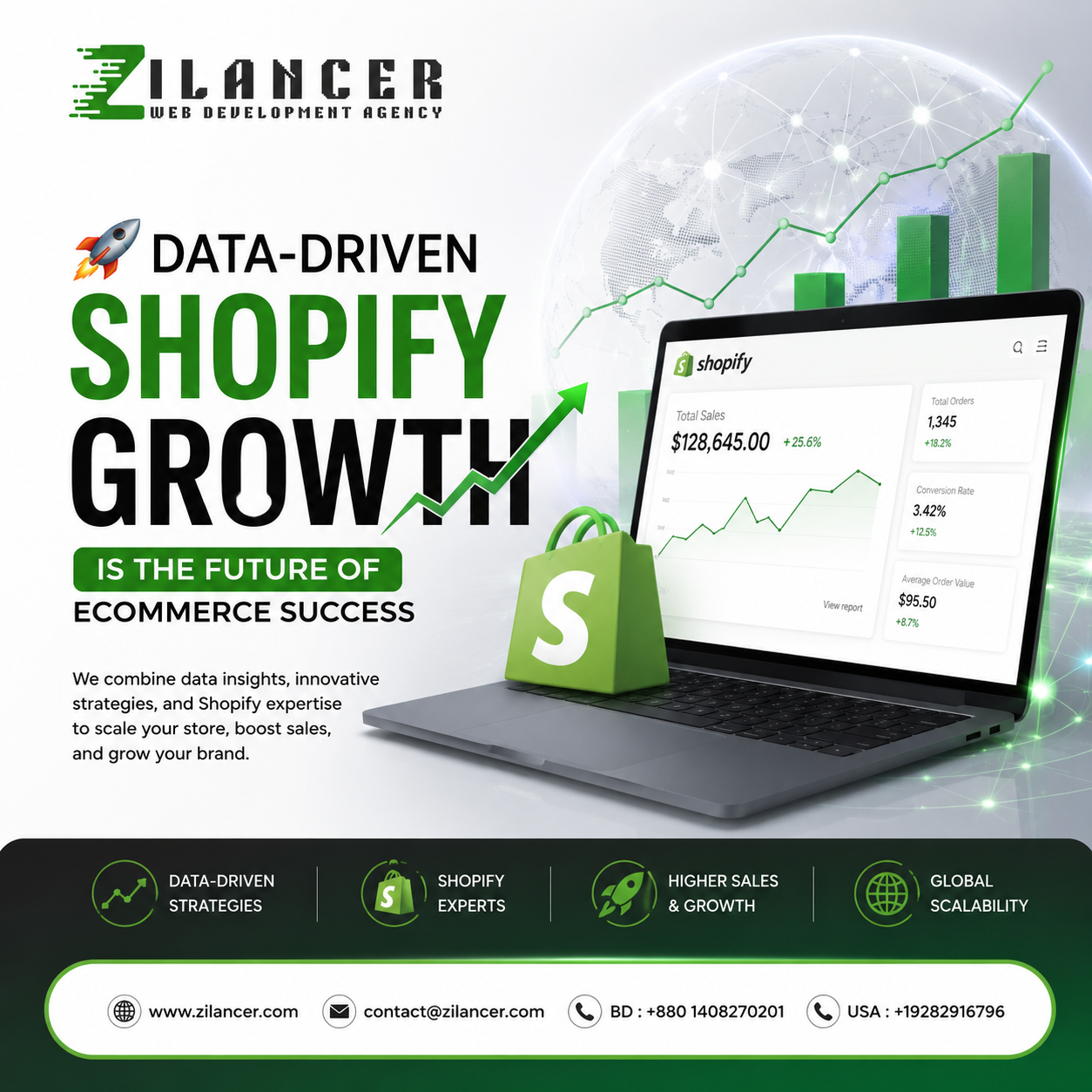
The modern eCommerce industry is evolving faster than ever before, and Shopify store owners are now facing a highly competitive digital marketplace where simply launching an online store is no longer enough. Businesses that want to grow sustainably must rely on data-driven decision-making rather than assumptions. A successful Shopify growth strategy today depends heavily on analytics, customer insights, behavioral tracking, conversion optimization, and continuous performance improvement. Brands that understand how to use their data effectively are the ones dominating search rankings, improving customer retention, increasing revenue, and building long-term customer loyalty. A data-driven Shopify growth strategy allows businesses to identify what is working, what is slowing down conversions, and where the biggest growth opportunities exist. From analyzing customer journeys to understanding user engagement patterns, every piece of information helps businesses optimize their online stores more intelligently. This is where professional Shopify agencies like Zilancer play an important role by helping businesses turn raw data into measurable eCommerce growth.
Why Data Matters in Modern Shopify Growth
In today’s highly competitive eCommerce landscape, data has become one of the most valuable assets for Shopify businesses that want to grow sustainably and outperform their competitors. Modern online stores can no longer rely on guesswork, assumptions, or outdated marketing methods to achieve success. Instead, brands must make informed decisions based on real customer behavior, analytics, and performance insights. This is why data-driven growth strategies have become essential for Shopify stores aiming to increase conversions, improve customer experience, and maximize long-term profitability. Every interaction inside a Shopify store generates valuable information. From the pages customers visit to the products they view, the time they spend browsing, and the moment they abandon their carts, each action provides insights into customer intent and shopping behavior. Businesses that analyze this data effectively gain a deeper understanding of what their customers truly want, allowing them to create more personalized and optimized shopping experiences. One of the biggest advantages of using data in Shopify growth is the ability to identify what is working and what is limiting performance. Without analytics, many businesses continue investing in ineffective marketing campaigns, poorly optimized product pages, or slow-loading store designs without understanding the real reasons behind low conversion rates. Data helps eliminate uncertainty by revealing clear patterns and measurable results that guide smarter business decisions.
Customer behavior analytics allow Shopify store owners to improve every stage of the buying journey. Businesses can discover which traffic sources generate the highest conversions, which products perform best, and which pages create the most engagement. This information helps brands optimize their content, product layouts, navigation systems, and checkout experiences to increase customer satisfaction and revenue growth. Data also plays a major role in improving Shopify SEO performance. Search engine optimization is no longer only about inserting keywords into content. Modern SEO requires understanding search intent, user engagement, bounce rates, click-through behavior, and technical performance metrics. By analyzing search data, businesses can target high-converting keywords, create more relevant content, and improve search rankings in a more strategic way. Another important benefit of data-driven Shopify growth is conversion rate optimization. Even small improvements in conversion rates can significantly impact revenue. Analytics tools help businesses test different headlines, product images, layouts, call-to-action buttons, and checkout experiences to determine which elements generate better results. Instead of redesigning a store based on assumptions, businesses can optimize their websites using measurable performance insights.
Website speed and performance optimization also rely heavily on data analysis. Slow-loading Shopify stores often experience higher bounce rates and lower customer retention. Performance tracking tools help identify issues such as unoptimized scripts, large image files, excessive app usage, and poor coding structures that negatively affect user experience. By solving these problems through data-backed optimization, businesses can improve both search rankings and customer satisfaction. Modern consumers also expect personalized online experiences, and data makes personalization possible. Customer data allows Shopify businesses to deliver targeted product recommendations, personalized email campaigns, dynamic offers, and customized shopping experiences based on user behavior and preferences. Personalized experiences help build stronger customer relationships, improve engagement, and increase repeat purchases.
At Zilancer, data-driven decision-making is integrated into every stage of Shopify growth and optimization. The agency focuses on combining advanced analytics with conversion-focused design, SEO strategy, speed optimization, and premium Shopify development to help businesses scale effectively. Rather than relying on generic solutions, Zilancer creates customized strategies based on real performance data and customer behavior insights. The future of Shopify’s growth will become even more data-centric as artificial intelligence, automation, and predictive analytics continue transforming the eCommerce industry. Businesses that understand how to leverage data effectively will gain a significant competitive advantage by creating faster, smarter, and more personalized online shopping experiences.
Ultimately, data matters in modern Shopify growth because it transforms decision-making from guesswork into strategy. It allows businesses to understand their customers more deeply, optimize performance continuously, and build scalable systems designed for long-term success. Shopify brands that embrace data-driven growth are better positioned to increase conversions, improve customer loyalty, and achieve sustainable eCommerce success in an increasingly competitive digital market .
Understanding Customer Behavior Through Analytics
In the modern eCommerce industry, understanding customer behavior has become one of the most important factors behind successful Shopify growth. Online businesses that truly understand how visitors interact with their stores can create better shopping experiences, improve conversion rates, and build stronger customer relationships. Analytics provides the foundation for this understanding by transforming customer actions into valuable business insights that guide smarter decision-making. Every visitor who enters a Shopify store leaves behind a trail of behavioral data. From the products they click to the pages they browse, the amount of time they spend on specific sections, and the exact moment they leave the website, each interaction reveals important information about customer intent and buying psychology. Businesses that learn how to analyze this information effectively gain a major competitive advantage in the eCommerce marketplace.
One of the biggest benefits of customer analytics is the ability to identify user behavior patterns. Shopify store owners can discover which products attract the most attention, which pages generate the highest engagement, and which marketing channels drive the most conversions. This level of insight allows businesses to focus their efforts on strategies that produce measurable results instead of relying on assumptions or guesswork. Analytics also helps businesses understand customer journeys more clearly. A customer journey refers to the complete path users take before making a purchase. Some visitors may arrive from search engines, browse multiple products, and complete a purchase immediately, while others may return several times before deciding to buy. By tracking these journeys, businesses can identify opportunities to improve navigation, simplify the checkout process, and reduce customer friction throughout the buying experience.
Cart abandonment analysis is another critical part of understanding customer behavior. Many Shopify stores experience lost sales because customers leave during the checkout process. Analytics tools help businesses identify where these drop-offs occur and why they happen. Sometimes customers leave because shipping costs are too high, pages load too slowly, or the checkout experience feels complicated. Understanding these problems allows businesses to implement targeted improvements that increase completed purchases and revenue growth. Behavioral analytics also plays an important role in conversion rate optimization. Businesses can analyze how customers interact with product pages, call-to-action buttons, banners, navigation menus, and promotional offers. Heatmaps and session recordings provide visual insights into customer engagement by showing where users click, scroll, and spend the most time. This information helps Shopify brands optimize layouts, improve product presentation, and create more user-friendly store experiences.
Another major advantage of customer analytics is audience segmentation. Not all customers behave the same way, and analytics allows businesses to group audiences based on behavior, demographics, purchasing habits, and engagement levels. This helps Shopify stores create more personalized marketing campaigns and shopping experiences. Personalized product recommendations, targeted email campaigns, and customized promotions become much more effective when businesses understand what different customer segments actually want. Analytics also supports data-driven content and SEO strategies. Businesses can track which blog posts generate the most traffic, which keywords attract high-converting visitors, and which landing pages perform best in search results. Understanding how users interact with content allows Shopify brands to create more relevant, engaging, and conversion-focused experiences that improve both search visibility and customer retention.
Mobile behavior tracking has become especially important in modern Shopify growth strategies because most online shoppers now browse and purchase through mobile devices. Analytics helps businesses understand how mobile users interact with their stores, which mobile pages create friction, and how responsive design impacts customer engagement. Optimizing the mobile experience based on real data can significantly improve conversion rates and customer satisfaction.
At Zilancer, understanding customer behavior through analytics is a core part of every Shopify optimization strategy. The agency focuses on helping businesses use real customer insights to improve website performance, increase conversions, and create more engaging shopping experiences. Instead of applying generic solutions, Zilancer develops customized strategies based on actual user behavior and measurable performance data. The agency combines advanced analytics tools with Shopify development expertise, SEO optimization, conversion rate optimization, and premium UX design to help businesses build smarter and more scalable online stores. By analyzing customer interactions in detail, Zilancer helps brands identify hidden growth opportunities and optimize every stage of the customer journey. As the eCommerce industry continues evolving, analytics will become even more important for Shopify businesses that want to remain competitive. Artificial intelligence, predictive analytics, and machine learning technologies are already helping businesses understand customer behavior on a deeper level. Brands that embrace data-driven insights today will be better prepared to create personalized, high-performing shopping experiences in the future.
Ultimately, understanding customer behavior through analytics allows Shopify businesses to move beyond assumptions and make strategic decisions based on real evidence. It helps brands improve user experiences, optimize conversions, strengthen customer relationships, and achieve sustainable long-term growth. Businesses that invest in analytics-driven optimization are far more likely to succeed in the increasingly competitive world of online commerce.
Conversion Rate Optimization and Revenue Growth
In the highly competitive world of eCommerce, driving traffic to a Shopify store is only the first step toward success. The real challenge lies in converting visitors into paying customers. Many online businesses spend significant amounts on advertising, SEO, and social media marketing but fail to achieve strong revenue growth because their stores are not optimized for conversions. This is where Conversion Rate Optimization, commonly known as CRO, becomes one of the most powerful strategies for increasing Shopify revenue and long-term business profitability. Conversion Rate Optimization is the process of improving a Shopify store to encourage more visitors to complete desired actions such as making purchases, subscribing to newsletters, adding products to carts, or engaging with promotional campaigns. Instead of focusing only on increasing traffic, CRO focuses on maximizing the value of existing traffic by improving the overall shopping experience and reducing customer friction.
A data-driven CRO strategy helps businesses understand why customers convert or why they leave without purchasing. Through analytics, behavioral tracking, and user testing, Shopify store owners can identify barriers that prevent users from completing transactions. These barriers may include slow loading speeds, confusing navigation, poor mobile responsiveness, weak product descriptions, complicated checkout processes, or lack of trust signals. One of the most important aspects of conversion rate optimization is understanding customer psychology. Online shoppers make purchasing decisions based on trust, convenience, clarity, and emotional connection. A well-optimized Shopify store creates a seamless shopping experience that guides users naturally toward conversion. Every design element, headline, product image, call-to-action button, and checkout interaction can influence customer behavior and purchasing decisions. Analytics tools play a major role in successful CRO strategies because they provide insights into how users interact with a store. Heatmaps, session recordings, click tracking, and funnel analysis reveal which areas of a website attract the most attention and where users experience frustration. Businesses can use this information to improve layouts, simplify navigation, and create more intuitive user experiences.
Product page optimization is another critical component of conversion rate optimization. Product pages are often the deciding factor between a sale and an abandoned session. High-quality product images, compelling descriptions, customer reviews, pricing clarity, and persuasive call-to-action sections all contribute to stronger conversion performance. Businesses that optimize product pages based on customer behavior data typically experience higher engagement and increased sales. Mobile optimization has also become essential for revenue growth because the majority of online shoppers now browse and purchase through smartphones and tablets. If a Shopify store performs poorly on mobile devices, customers are more likely to leave before completing purchases. Conversion-focused mobile optimization ensures that navigation, images, checkout forms, and interactive elements function smoothly across all screen sizes. Checkout optimization is another major factor affecting revenue growth. Many customers abandon their carts during checkout due to unnecessary complexity or hidden costs. A streamlined checkout experience with clear pricing, secure payment methods, guest checkout options, and minimal distractions can significantly improve completed transactions. Reducing checkout friction often leads directly to increased sales and higher customer satisfaction.
Trust-building elements also have a powerful influence on conversion rates. Customers are more likely to purchase from Shopify stores that appear secure, professional, and credible. Trust badges, customer reviews, transparent return policies, secure payment icons, and authentic brand storytelling all help increase buyer confidence. When customers feel safe and informed, they are far more likely to complete purchases. A/B testing is one of the most effective CRO techniques for improving Shopify performance. Businesses can test different headlines, layouts, button designs, colors, product images, and promotional offers to determine which variations generate the best results. Instead of making changes based on assumptions, businesses use real customer data to guide optimization decisions and improve overall store performance.
Conversion rate optimization also directly impacts advertising profitability. When a Shopify store converts visitors more effectively, businesses can generate more revenue from the same advertising budget. This improves return on investment and allows brands to scale their marketing efforts more sustainably. Even small increases in conversion rates can produce significant revenue growth over time. At Zilancer, conversion-focused Shopify optimization is a core part of the agency’s growth strategy. The team combines advanced analytics, premium design principles, SEO expertise, speed optimization, and customer behavior insights to create high-performing Shopify stores designed to maximize conversions and revenue. Rather than relying on generic design trends, Zilancer develops customized CRO strategies based on measurable user data and business goals.
The agency focuses on improving every stage of the customer journey, from homepage engagement to checkout completion. By optimizing store structure, improving website speed, refining user experiences, and implementing strategic design enhancements, Zilancer helps businesses increase customer engagement and drive sustainable revenue growth. As the eCommerce industry continues evolving, conversion rate optimization will become even more important for online businesses seeking long-term success. Increasing competition, changing customer expectations, and rising advertising costs make it essential for Shopify stores to maximize the performance of every visitor interaction.
Ultimately, Conversion Rate Optimization is not simply about improving design elements or increasing sales percentages. It is about creating better customer experiences that encourage trust, simplify shopping journeys, and support long-term business growth. Shopify businesses that invest in CRO gain a major competitive advantage by turning more visitors into loyal customers while maximizing the profitability of their online stores. For modern Shopify brands, revenue growth is no longer driven by traffic alone. Sustainable success comes from understanding customer behavior, optimizing user experiences, and continuously improving store performance through data-driven conversion strategies. Businesses that prioritize CRO today will be far better positioned to scale successfully in the future of eCommerce.
The Future of Data-Driven Shopify eCommerce
The future of Shopify eCommerce is becoming increasingly driven by data, automation, artificial intelligence, and customer behavior insights. As online competition continues to grow across every industry, businesses can no longer depend on traditional marketing strategies or generic store designs to achieve sustainable success. Modern consumers expect faster, smarter, and more personalized shopping experiences, and the brands that leverage data effectively will lead the future of digital commerce. Data-driven eCommerce is transforming the way Shopify businesses operate, market, and scale. Instead of relying on assumptions, successful brands now make decisions based on real-time analytics, customer behavior tracking, predictive insights, and performance metrics. This shift allows businesses to understand their customers more deeply, optimize every stage of the shopping journey, and create highly personalized experiences that increase both conversions and long-term customer loyalty. Artificial intelligence will play one of the biggest roles in the future of Shopify growth. AI-powered tools are already helping businesses analyze massive amounts of customer data to identify buying patterns, predict future purchasing behavior, and automate marketing strategies. In the coming years, Shopify stores will increasingly use AI to recommend products, personalize customer experiences, automate customer support, optimize inventory management, and improve advertising performance.
Predictive analytics is another major innovation shaping the future of eCommerce. Instead of reacting to customer behavior after it happens, predictive technologies allow businesses to forecast trends before they occur. Shopify brands will be able to anticipate customer needs, identify high-value audiences, predict product demand, and create targeted marketing campaigns with far greater accuracy. This level of intelligent forecasting will help businesses reduce operational risks while maximizing profitability and customer retention. Personalization will become even more important as consumer expectations continue evolving. Modern customers expect online shopping experiences that feel tailored specifically to their interests and behaviors. Data-driven personalization enables Shopify businesses to display relevant products, customized offers, dynamic content, and targeted promotions based on browsing history, purchase behavior, demographics, and engagement patterns. Future Shopify stores will rely heavily on personalized customer journeys powered by advanced analytics and machine learning algorithms. Businesses that fail to personalize their experiences may struggle to compete against brands offering smarter and more engaging digital shopping environments. Customers are far more likely to interact with brands that understand their preferences and deliver relevant shopping experiences in real time.
Automation will also reshape the future of Shopify eCommerce by streamlining operations and improving efficiency. Tasks that previously required manual effort, such as email marketing, customer segmentation, product recommendations, retargeting campaigns, and inventory updates, are becoming increasingly automated through intelligent systems. Automation not only saves time but also improves consistency, scalability, and customer satisfaction. Another major trend influencing the future of data-driven Shopify growth is the rise of omnichannel commerce. Customers now interact with brands across multiple platforms including websites, mobile apps, social media channels, marketplaces, and email campaigns. Data integration across these channels allows businesses to create unified customer experiences and maintain consistent brand interactions throughout the entire buying journey. Shopify businesses that successfully connect customer data from multiple touchpoints will gain a stronger understanding of user behavior and engagement. This enables brands to create more accurate targeting strategies, improve customer retention, and increase lifetime customer value. Omnichannel analytics will become a key component of future eCommerce success.
Website speed and user experience optimization will continue to play a major role in Shopify growth strategies. Search engines and consumers both prioritize fast, responsive, and mobile-friendly websites. As competition increases, even small performance issues can negatively impact customer trust and conversion rates. Future Shopify stores will focus heavily on performance optimization, Core Web Vitals improvements, clean coding practices, and seamless mobile experiences. Voice search, visual search, and AI-powered shopping assistants are also expected to influence the future of eCommerce behavior. Customers are increasingly using voice-enabled devices and image-based search tools to discover products online. Shopify businesses that adapt their SEO strategies and product structures for these technologies will have an advantage in future digital marketplaces.
Data privacy and customer trust will become even more critical as data collection technologies continue evolving. Customers are becoming more aware of how their information is used online, which means Shopify businesses must focus on transparency, security, and ethical data practices. Brands that build trust through secure shopping experiences and responsible data handling will strengthen customer loyalty and long-term brand reputation. At Zilancer, the future of Shopify eCommerce is approached through innovation, analytics, and performance-driven strategies. The agency focuses on helping businesses prepare for the next generation of digital commerce by combining advanced Shopify development with data-focused optimization techniques. From AI-powered personalization to conversion rate optimization and technical SEO improvements, Zilancer helps brands build scalable eCommerce systems designed for long-term success.
The agency understands that future-ready Shopify stores require more than attractive design alone. Businesses need intelligent infrastructure, high-performance functionality, customer behavior analysis, and strategic growth systems that adapt to evolving market trends. By leveraging modern analytics tools and advanced development practices, Zilancer helps businesses stay competitive in an increasingly data-driven eCommerce environment.
The future of Shopify eCommerce will belong to businesses that embrace innovation, analytics, and customer-focused optimization. Brands that understand how to use data effectively will be able to create smarter shopping experiences, improve customer engagement, and achieve sustainable revenue growth in highly competitive markets.
Ultimately, data-driven Shopify eCommerce is not simply a trend but the foundation of modern online business success. As technology continues advancing, businesses that invest in analytics, automation, AI, personalization, and performance optimization will gain a significant competitive advantage. The future of eCommerce will reward brands that combine creativity with intelligent decision-making to build faster, smarter, and more customer-centric online experiences.
Why Businesses Choose Zilancer for Shopify Growth
In today’s rapidly evolving eCommerce industry, businesses need more than just a visually attractive Shopify store to achieve long-term success. Modern online brands require strategic growth solutions, high-performance development, conversion-focused design, advanced SEO optimization, and data-driven decision-making to remain competitive in crowded digital marketplaces. This is why many businesses choose Zilancer as their trusted Shopify growth partner. Zilancer has built a strong reputation by helping Shopify businesses create scalable, high-performing, and conversion-focused online stores designed to support sustainable growth. The agency combines technical expertise, premium design standards, advanced optimization strategies, and customer-focused solutions to help brands maximize their eCommerce potential.
One of the main reasons businesses choose Zilancer is the agency’s deep specialization in Shopify development and optimization. Rather than offering generalized web services, Zilancer focuses heavily on Shopify and Shopify Plus solutions, allowing the team to develop advanced expertise in the platform’s ecosystem. This specialized knowledge helps businesses implement powerful eCommerce strategies tailored specifically for Shopify growth. Zilancer understands that every online business has unique goals, challenges, and customer expectations. Instead of using one-size-fits-all approaches, the agency creates customized Shopify solutions based on each brand’s specific needs. From startups launching their first online store to established enterprises scaling internationally, Zilancer develops personalized strategies designed to support measurable business growth. Another major reason businesses trust Zilancer is the agency’s focus on performance-driven Shopify development. Modern customers expect fast-loading, responsive, and seamless online shopping experiences. Slow websites, poor navigation, and complicated user interfaces can significantly reduce conversions and customer retention. Zilancer prioritizes speed optimization, clean coding practices, responsive design, and performance improvements to ensure Shopify stores deliver exceptional user experiences across all devices.
Conversion-focused design is another area where Zilancer stands out. A visually attractive store alone does not guarantee business success. Effective Shopify design must also guide users naturally toward conversions while maintaining strong usability and brand identity. Zilancer combines premium UI and UX design principles with conversion rate optimization strategies to create Shopify stores that not only look professional but also generate measurable revenue growth. The agency places strong emphasis on customer behavior analysis and data-driven optimization. Successful Shopify growth requires understanding how users interact with online stores, where they experience friction, and what influences purchasing decisions. Zilancer uses analytics, behavioral insights, conversion tracking, and performance data to optimize every stage of the customer journey. This strategic approach helps businesses make smarter decisions based on measurable results rather than assumptions.
SEO expertise is another important reason businesses choose Zilancer for Shopify growth. Organic traffic remains one of the most valuable long-term growth channels for eCommerce brands. Zilancer helps businesses improve search visibility through advanced Shopify SEO strategies including technical optimization, keyword targeting, content structure improvements, Core Web Vitals optimization, mobile responsiveness, and user-focused website architecture. By combining SEO with high-performance development and conversion optimization, Zilancer helps businesses attract qualified traffic while maximizing revenue opportunities. The agency understands that successful SEO is not only about rankings but also about creating engaging user experiences that convert visitors into loyal customers.
Zilancer is also recognized for its ability to develop scalable Shopify solutions that support long-term business expansion. As eCommerce brands grow, their operational and technical requirements become more complex. The agency builds flexible Shopify infrastructures capable of handling increased traffic, larger product catalogs, advanced integrations, and evolving customer expectations without sacrificing performance or usability. Businesses also value Zilancer’s focus on innovation and future-ready development. The eCommerce industry changes rapidly, and brands must continuously adapt to new technologies, customer behaviors, and digital trends. Zilancer stays updated with the latest Shopify advancements, AI-driven optimization strategies, automation technologies, and modern eCommerce practices to help businesses remain competitive in evolving markets. Strong communication and client collaboration are additional factors that make Zilancer a preferred Shopify agency. Successful eCommerce growth requires ongoing strategic planning, transparency, and effective problem-solving. Zilancer works closely with clients throughout the development and optimization process, ensuring that every project aligns with business objectives and growth goals.
The agency also provides comprehensive Shopify services under one roof, allowing businesses to streamline their growth strategies without managing multiple service providers. From Shopify store development and redesign to SEO optimization, CRO implementation, speed enhancement, app integration, and custom functionality development, Zilancer offers complete eCommerce growth solutions designed to simplify the scaling process. Another reason businesses continue partnering with Zilancer is the agency’s commitment to delivering measurable results. Every optimization strategy, design enhancement, and technical improvement is focused on improving key business metrics such as conversion rates, user engagement, customer retention, website performance, and revenue growth. This results-oriented mindset helps businesses achieve stronger returns on their digital investments. In a highly competitive eCommerce landscape, trust and reliability are extremely important when choosing a Shopify agency. Businesses need a partner capable of understanding market trends, solving technical challenges, and implementing strategies that support sustainable long-term growth. Zilancer has positioned itself as a trusted Shopify growth agency by consistently delivering professional, scalable, and performance-focused eCommerce solutions.
As the future of online commerce becomes increasingly data-driven and customer-focused, businesses require more advanced growth strategies than ever before. Zilancer helps brands navigate this evolving digital environment by combining creativity, technical expertise, analytics, and strategic optimization into complete Shopify growth systems. Ultimately, businesses choose Zilancer because the agency understands that successful Shopify growth requires far more than basic website development. It requires a strategic combination of design, performance, analytics, SEO, conversion optimization, scalability, and customer experience enhancement. By focusing on these critical elements, Zilancer helps Shopify businesses build stronger online brands, improve profitability, and achieve long-term eCommerce success.
A data-driven Shopify growth strategy is no longer optional for modern online businesses. In today’s competitive eCommerce environment, brands must use analytics, customer insights, SEO strategies, performance optimization, and conversion-focused design to achieve sustainable success.