





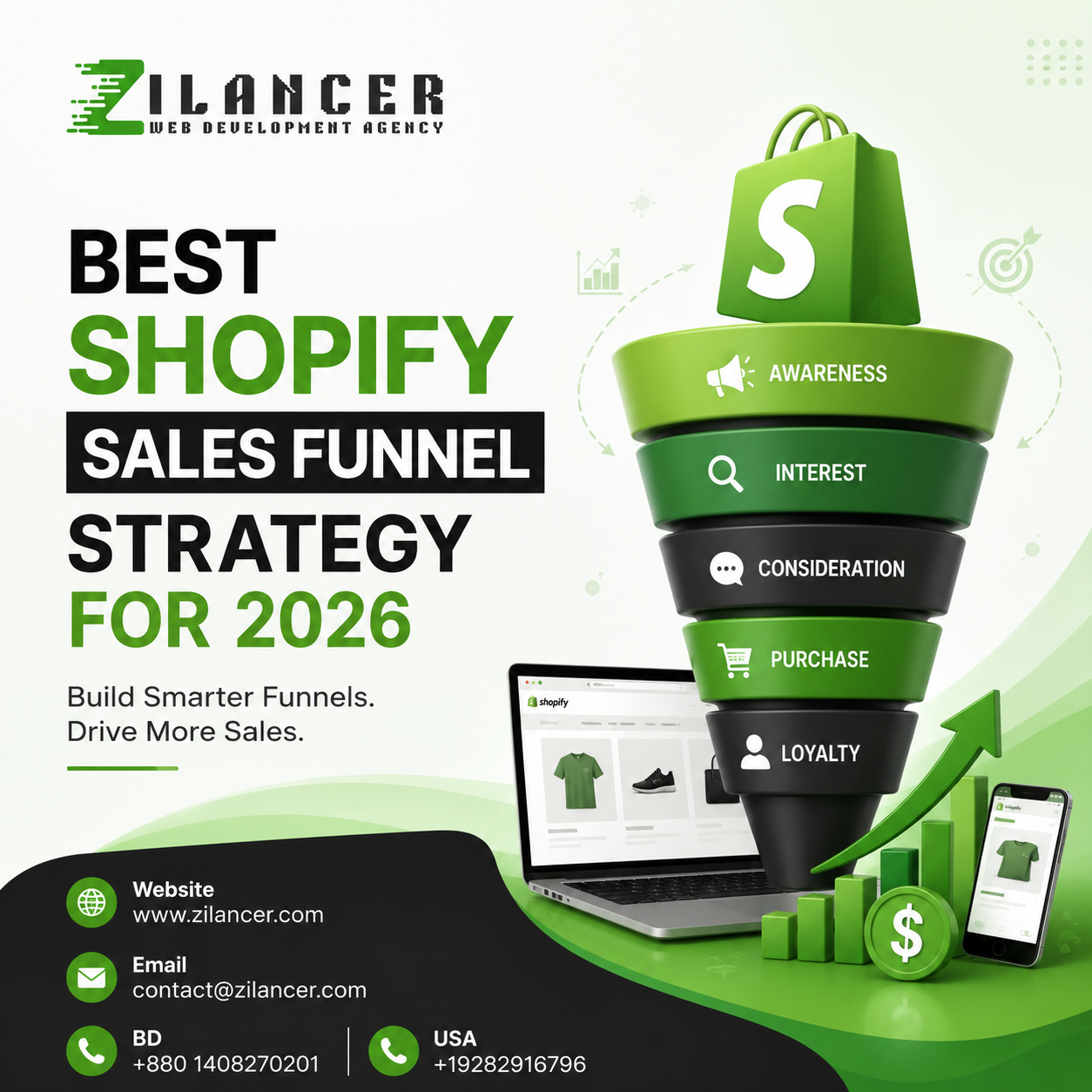
The Shopify eCommerce industry is becoming more competitive every year. In 2026, simply launching a Shopify store and running ads is no longer enough to generate consistent sales. Customers are becoming smarter, competition is growing rapidly, advertising costs are increasing, and user expectations are higher than ever before. Brands that want long-term success must focus on building a complete Shopify sales funnel strategy instead of relying on random marketing efforts. A successful Shopify sales funnel helps businesses attract the right audience, build trust, guide visitors through the buying journey, and convert them into loyal customers. The best Shopify sales funnel strategy for 2026 focuses on customer experience, automation, personalization, trust-building, retention marketing, and data-driven optimization.
At Zilancer, we help Shopify businesses build powerful conversion-focused sales funnels that increase revenue and maximize return on investment. Our Shopify experts work closely with brands to optimize every stage of the customer journey, from traffic generation to post-purchase retention.
Understanding the Shopify Sales Funnel in 2026
The Shopify sales funnel in 2026 is far more advanced than the traditional eCommerce funnels used in previous years. Modern online shoppers expect fast, personalized, and seamless shopping experiences across every device and platform. Because of this, Shopify store owners can no longer rely only on attractive products or paid advertising to generate consistent sales. Instead, businesses must build a complete customer journey that guides visitors from discovery to purchase and eventually turns them into loyal repeat customers. A Shopify sales funnel is the process customers go through before making a purchase from an online store. It begins the moment someone discovers your brand through search engines, social media, paid ads, email marketing, or influencer promotions. From there, customers move through different stages including awareness, interest, consideration, conversion, and retention. Every stage of the funnel plays a critical role in determining whether a visitor becomes a paying customer or leaves the website without buying anything. In 2026, successful Shopify brands focus heavily on customer experience and conversion optimization. The awareness stage is all about attracting the right audience through Shopify SEO, content marketing, social media campaigns, YouTube videos, Pinterest marketing, and paid advertising. Brands that create valuable content and optimize their online visibility can attract highly targeted traffic that is more likely to convert into customers.
Once visitors land on a Shopify store, the interest stage begins. This is where website design, branding, page speed, and user experience become extremely important. Customers judge a brand within seconds, so Shopify stores must create strong first impressions with professional layouts, mobile-friendly design, easy navigation, and compelling messaging. A slow or confusing website can immediately push customers away and damage conversion rates. The consideration stage focuses on building trust and helping customers feel confident about purchasing. In 2026, shoppers expect detailed product descriptions, professional product photography, customer reviews, trust badges, FAQs, return policies, and social proof before they make buying decisions. High-converting Shopify stores also use video content, user-generated content, and influencer testimonials to increase credibility and reduce hesitation.
The conversion stage is where customers finally complete their purchases. This stage depends heavily on checkout optimization. Shopify stores with simplified checkout experiences, multiple payment methods, transparent pricing, and fast-loading pages achieve significantly better conversion rates. Cart abandonment remains one of the biggest challenges in eCommerce, which is why businesses must remove friction and make the buying process as smooth as possible. The final stage of the Shopify sales funnel is retention and customer loyalty. In 2026, retaining customers is often more profitable than constantly acquiring new ones. Successful Shopify brands use email marketing automation, loyalty programs, personalized offers, retargeting ads, and post-purchase communication to encourage repeat purchases. Customers who have positive experiences are more likely to become loyal buyers and recommend the brand to others.
Modern Shopify sales funnels also rely heavily on automation and artificial intelligence. Businesses now use automated email sequences, AI-driven product recommendations, chatbot support, predictive analytics, and personalized shopping experiences to improve customer engagement and increase sales. Automation allows brands to scale efficiently while delivering highly customized experiences to every customer. At Zilancer, we help Shopify businesses build complete sales funnel strategies designed specifically for growth in 2026. From Shopify SEO and conversion optimization to store design, email automation, and customer retention systems, our team focuses on creating high-converting Shopify experiences that drive long-term business success.
Why Shopify Sales Funnels Matter More in 2026
The eCommerce industry is evolving faster than ever, and Shopify store owners are facing increasing competition in every niche. In 2026, simply launching a Shopify store and running a few advertisements is no longer enough to achieve consistent growth. Customer expectations have changed dramatically, advertising costs continue to rise, and online shoppers now demand personalized, fast, and trustworthy experiences before making purchasing decisions. This is why Shopify sales funnels matter more in 2026 than ever before. A Shopify sales funnel helps businesses guide customers through every stage of the buying journey. Instead of relying on random traffic and hoping visitors purchase products, a structured funnel strategically moves potential customers from awareness to conversion and eventually into loyal repeat buyers. Brands that understand this process are able to generate more sales, increase customer retention, and maximize profitability over the long term.
One of the biggest reasons Shopify sales funnels are essential in 2026 is the rising cost of customer acquisition. Paid advertising platforms such as Facebook, Instagram, TikTok, and Google Ads have become more competitive, causing businesses to spend significantly more money to attract visitors. Without a proper sales funnel, much of this traffic is wasted because customers leave the website without converting. A well-optimized funnel ensures that every visitor has a higher chance of becoming a customer, helping businesses achieve better returns on their marketing investments.Customer behavior has also changed significantly in recent years. Modern shoppers rarely purchase products immediately after discovering a brand. Instead, they research products, compare competitors, read reviews, watch videos, and interact with brands across multiple platforms before making final decisions. Shopify sales funnels help businesses stay connected with customers throughout this entire journey using retargeting ads, email marketing, personalized offers, and content marketing strategies. Another major reason sales funnels matter in 2026 is the growing importance of customer experience. Today’s customers expect websites to load quickly, look professional, work perfectly on mobile devices, and provide seamless navigation. If a Shopify store feels confusing, slow, or untrustworthy, visitors quickly leave and purchase from competitors instead. Sales funnels focus heavily on improving user experience by optimizing every interaction customers have with the brand.
Conversion rate optimization has also become a critical factor for Shopify’s success. Increasing traffic alone is no longer enough because low conversion rates can destroy profitability. Shopify sales funnels help businesses improve product pages, checkout systems, calls-to-action, trust signals, and customer engagement strategies to maximize conversions. Even small improvements in conversion rates can dramatically increase revenue over time. In 2026, retention marketing is equally important as customer acquisition. Successful Shopify businesses understand that repeat customers generate more profit than one-time buyers. A powerful sales funnel continues working even after the first purchase by using email automation, loyalty programs, personalized recommendations, and post-purchase follow-ups to encourage future sales. This creates stronger customer relationships and increases lifetime customer value. Automation and artificial intelligence are also transforming Shopify sales funnels in 2026. Modern businesses use AI-powered product recommendations, automated email sequences, customer behavior tracking, and predictive analytics to create highly personalized shopping experiences. These technologies help Shopify brands understand customer preferences and deliver relevant marketing messages at exactly the right moment.
Social proof and trust-building have become more important than ever as well. Customers want reassurance before spending money online. Shopify funnels help businesses build credibility through customer reviews, testimonials, user-generated content, influencer partnerships, and trust badges. Strong trust signals reduce hesitation and encourage customers to complete purchases confidently. Mobile commerce continues to dominate the eCommerce industry, making mobile optimization a crucial part of every Shopify sales funnel. Most online shoppers now browse and purchase products using smartphones, meaning Shopify stores must provide fast and seamless mobile experiences. Businesses that fail to optimize for mobile users risk losing a significant portion of potential customers. At Zilancer, we help Shopify businesses create advanced sales funnel strategies designed specifically for the modern eCommerce market. Our team focuses on conversion optimization, Shopify SEO, mobile responsiveness, automation, customer retention, and complete funnel development to help brands grow successfully in 2026. We believe that a strong Shopify sales funnel is no longer optional for online businesses. It is now one of the most important foundations for long-term eCommerce success.
The Awareness Stage of the Shopify Funnel
The awareness stage is the very first and one of the most important parts of the Shopify sales funnel. This is the stage where potential customers discover your brand for the first time. Before anyone purchases a product, they first need to know your business exists. In 2026, attracting attention online is more competitive than ever, which is why Shopify brands must build strong awareness strategies to stand out in crowded markets.The main goal of the awareness stage is to introduce your Shopify store to the right audience and create a strong first impression. Businesses need to attract people who are genuinely interested in their products or services. Quality traffic matters far more than simply generating large numbers of visitors because targeted audiences are much more likely to move deeper into the sales funnel and eventually convert into paying customers.Search engine optimization plays a massive role in the awareness stage of the Shopify funnel. When customers search for products on Google, Shopify stores that rank higher in search results receive more organic traffic and visibility. In 2026, Shopify SEO involves much more than simply adding keywords to product pages. Brands must focus on technical SEO, mobile optimization, fast-loading pages, structured content, optimized images, and high-quality blog articles to improve search rankings and attract relevant visitors.
Content marketing is another powerful strategy during the awareness stage. Modern customers want useful information before they make purchasing decisions. Shopify brands that create educational blog posts, buying guides, tutorials, case studies, and informative videos are able to build trust and authority in their industry. Valuable content helps businesses attract customers naturally through search engines and social media while positioning the brand as a reliable source of information. Social media marketing has become one of the strongest awareness tools for Shopify stores in 2026. Platforms like Instagram, TikTok, Facebook, Pinterest, and YouTube allow brands to showcase products visually and connect emotionally with audiences. Short-form video content, product demonstrations, behind-the-scenes clips, influencer collaborations, and engaging social media campaigns help Shopify businesses expand their reach and attract new potential customers daily. Paid advertising also remains an important part of the awareness stage. Shopify businesses use Facebook Ads, Google Ads, TikTok Ads, Pinterest Ads, and YouTube advertising to reach targeted audiences quickly. However, modern advertising strategies are becoming more sophisticated because consumers now see thousands of ads every day. Successful brands focus on creative storytelling, emotional branding, audience targeting, and compelling visuals to capture attention effectively.
Influencer marketing continues to grow rapidly in 2026 as well. Customers often trust recommendations from creators and influencers more than traditional advertisements. Shopify brands that collaborate with influencers can expose their products to highly engaged audiences while building credibility and trust much faster. Authentic influencer partnerships can generate strong awareness and drive high-quality traffic into the sales funnel. Brand identity is another critical factor during the awareness stage. Customers remember brands that have strong visual consistency, professional design, unique messaging, and emotional storytelling. Shopify businesses must focus on logo design, color schemes, typography, brand voice, and overall presentation to create memorable experiences that differentiate them from competitors. Mobile optimization is especially important at this stage because most online traffic now comes from smartphones and tablets. If a Shopify store is not optimized for mobile users, businesses risk losing large amounts of traffic immediately. Fast-loading pages, responsive design, easy navigation, and mobile-friendly content are essential for keeping visitors engaged after they discover the brand.
Video marketing is becoming one of the most effective awareness strategies in the Shopify industry. Customers engage heavily with video content because it communicates information quickly and creates stronger emotional connections. Shopify brands use product videos, educational content, customer testimonials, tutorials, and social media reels to increase visibility and capture audience attention. The awareness stage is not only about generating traffic but also about attracting the right customers who are most likely to purchase products later in the funnel. Businesses that target broad, untargeted audiences often waste marketing budgets and struggle with low conversion rates. Successful Shopify stores focus on understanding customer behavior, audience interests, pain points, and purchasing intent to create highly targeted awareness campaigns.
At Zilancer, we help Shopify businesses build powerful awareness strategies designed specifically for modern eCommerce growth. Our team specializes in Shopify SEO, content marketing, social media growth, paid advertising, conversion optimization, and brand positioning to help businesses attract the right audience and create lasting impressions. We believe the awareness stage is the foundation of every successful Shopify sales funnel because, without visibility, even the best products and websites cannot generate consistent sales.
Shopify Checkout Optimization Strategy
The checkout stage is one of the most critical parts of the Shopify sales funnel because this is where customers finally decide whether to complete their purchase or leave the store without buying anything. In 2026, Shopify checkout optimization is more important than ever because online shoppers expect fast, smooth, secure, and hassle-free buying experiences. Even if a Shopify store has excellent products, strong branding, and high traffic, poor checkout experiences can still cause massive revenue loss through cart abandonment.Shopify checkout optimization focuses on reducing friction and making the purchasing process as simple and comfortable as possible for customers. Every unnecessary step, confusing field, slow-loading page, or unexpected cost increases the chances of customers abandoning their carts before completing payment. Successful Shopify brands understand that improving checkout experiences directly increases conversion rates and overall profitability.
One of the biggest reasons customers abandon checkout pages is unexpected costs. Hidden shipping fees, taxes, or additional charges often frustrate buyers and create distrust. In 2026, transparency is extremely important for customer satisfaction. Shopify stores should clearly display shipping costs, taxes, delivery times, and return policies before customers reach the final payment stage. Honest pricing creates confidence and reduces checkout abandonment significantly. Page speed is another major factor in Shopify checkout optimization. Modern online shoppers expect websites to load instantly, especially on mobile devices. Slow-loading checkout pages increase frustration and cause customers to leave before completing transactions. Shopify stores must optimize images, reduce unnecessary scripts, improve server performance, and use lightweight designs to ensure the checkout process remains fast and responsive. Mobile optimization is essential because most Shopify traffic now comes from smartphones and tablets. Customers frequently shop while browsing social media, watching videos, or searching online using mobile devices. If the checkout experience feels difficult on smaller screens, businesses lose valuable sales opportunities. High-converting Shopify stores use mobile-friendly layouts, simplified forms, large buttons, and easy navigation to create seamless mobile checkout experiences.
Offering multiple payment methods is another important part of checkout optimization in 2026. Customers prefer flexibility when making payments, and different regions often have different preferred payment systems. Successful Shopify stores support major credit cards, PayPal, Apple Pay, Google Pay, Shop Pay, and local payment gateways whenever possible. Providing multiple secure payment options increases customer confidence and improves conversion rates. Trust-building elements also play a critical role during checkout. Customers want reassurance that their payment information is secure and that the business is legitimate. Shopify stores should display SSL security badges, trust icons, customer reviews, refund policies, secure payment logos, and contact information throughout the checkout process. These trust signals help reduce hesitation and encourage customers to complete purchases confidently. Guest checkout functionality is becoming increasingly important as well. Many online shoppers do not want to create accounts before buying products. Forcing account registration adds unnecessary friction and can increase cart abandonment rates. Shopify stores that offer guest checkout options often achieve better conversion performance because they allow customers to complete purchases quickly without additional barriers.
Simplifying checkout forms is another powerful optimization strategy. Long or complicated forms create frustration and slow down the purchasing process. Shopify stores should only request essential customer information and eliminate unnecessary fields whenever possible. Autofill features, address suggestions, and one-click payment options help speed up checkout and improve the overall customer experience.Cart recovery strategies are also essential for modern Shopify stores. Many customers leave checkout pages without purchasing due to distractions, uncertainty, or hesitation. Automated abandoned cart emails, retargeting ads, SMS reminders, and personalized offers help businesses recover lost sales and bring customers back into the funnel. In 2026, automated recovery systems will remain one of the highest-performing Shopify marketing strategies.
One-page checkout systems are becoming increasingly popular because they reduce the number of steps customers must complete before purchasing. Simplified checkout layouts improve user experience and reduce drop-off rates significantly. Shopify stores that streamline the checkout journey often see major improvements in conversion rates. Personalization is also shaping the future of Shopify checkout optimization. Modern customers expect relevant product recommendations, personalized discounts, localized payment methods, and customized shopping experiences. Shopify brands that use AI-powered personalization can increase average order value while improving customer satisfaction during checkout. Shipping speed and delivery communication also influence checkout success. Customers want clear information about estimated delivery dates, tracking updates, and shipping reliability before finalizing purchases. Fast shipping options and transparent communication help build trust and improve customer confidence.
At Zilancer, we help Shopify businesses create high-converting checkout experiences designed to maximize sales and reduce cart abandonment. Our Shopify experts focus on speed optimization, mobile responsiveness, trust-building, payment integration, conversion optimization, and customer experience improvements to help brands increase revenue effectively. We believe that a well-optimized Shopify checkout strategy is one of the most powerful ways to improve eCommerce performance and achieve long-term business growth in 2026.
Mobile Optimization for Shopify Funnels
Mobile optimization has become one of the most important factors for Shopify’s success in 2026. The majority of online shoppers now browse products, compare prices, engage with advertisements, and complete purchases directly from smartphones and tablets. Because of this major shift in customer behavior, Shopify businesses must prioritize mobile experiences throughout every stage of their sales funnels. A poorly optimized mobile store can lead to high bounce rates, low conversions, abandoned carts, and lost revenue, even if the products and marketing strategies are strong.A Shopify sales funnel is designed to guide visitors from awareness to conversion, but mobile users behave differently from desktop users. Mobile shoppers expect speed, simplicity, and convenience. They want websites to load instantly, navigation to feel effortless, and checkout processes to be smooth and frustration-free. If a Shopify store feels slow, cluttered, or difficult to use on a mobile device, customers quickly leave and move to competitors.
Website loading speed is one of the most critical aspects of mobile optimization. Mobile users often browse while multitasking, commuting, or using slower internet connections. Even a few seconds of delay can dramatically reduce conversion rates. In 2026, Shopify brands must optimize images, minimize heavy scripts, compress files, and improve overall website performance to ensure pages load quickly across all mobile devices. Faster websites not only improve customer experience but also help increase search engine rankings on Google.Responsive design is another essential part of mobile optimization for Shopify funnels. A responsive Shopify store automatically adjusts its layout and content based on screen size, ensuring that every visitor receives a clean and user-friendly experience. Text should be easy to read, images should scale correctly, buttons should be simple to tap, and navigation menus should remain smooth on smaller screens. A responsive design creates a professional impression and helps customers browse products comfortably.
Navigation plays a major role in mobile conversion optimization. Mobile shoppers prefer simple and intuitive website structures because smaller screens can quickly become overwhelming if too much information is displayed at once. Shopify stores should use clean menus, clear categories, search functionality, and streamlined layouts to help users find products quickly. Easy navigation reduces frustration and keeps customers engaged throughout the shopping journey. Mobile-friendly product pages are especially important because they directly impact purchasing decisions. Product images should load quickly while maintaining high quality. Product descriptions must be easy to scan, and important details such as pricing, reviews, shipping information, and call-to-action buttons should remain clearly visible without requiring excessive scrolling. Video content is also highly effective on mobile devices because it helps customers understand products faster and increases engagement significantly.
Checkout optimization is another critical part of mobile Shopify funnels. Many customers abandon purchases during checkout because forms feel too long or difficult to complete on smaller screens. Shopify businesses should simplify checkout forms, enable autofill features, offer express payment methods, and reduce unnecessary steps to create faster mobile purchasing experiences. Mobile-friendly payment options like Apple Pay, Google Pay, Shop Pay, and PayPal make transactions easier and increase conversion rates. Touch-friendly design elements are becoming increasingly important in 2026. Mobile users interact with websites using their fingers rather than a mouse, which means buttons, menus, and links must be large enough to tap comfortably. Small or crowded elements create frustration and increase accidental clicks, damaging the user experience. Shopify stores should prioritize spacing, button visibility, and thumb-friendly layouts to improve usability. Mobile optimization also directly affects Shopify SEO performance. Google uses mobile-first indexing, meaning the mobile version of a website plays a major role in search engine rankings. Shopify stores with poor mobile performance may struggle to rank well in search results, reducing organic traffic opportunities. Optimizing for mobile devices helps businesses improve visibility while attracting more targeted visitors from search engines.
Social media traffic is another reason why mobile optimization matters more than ever. Platforms like Instagram, TikTok, Facebook, Pinterest, and YouTube generate massive amounts of mobile traffic for Shopify stores. When users click advertisements or social media links, they expect landing pages to load quickly and function perfectly on mobile devices. A poor mobile experience can waste advertising budgets and lower campaign performance dramatically.Customer trust and brand perception are also influenced by mobile experiences. Modern shoppers associate fast, polished, and responsive mobile websites with professionalism and credibility. On the other hand, outdated or difficult-to-use mobile stores create negative impressions that reduce customer confidence. Shopify brands that invest in premium mobile experiences build stronger trust and improve customer retention over time. In 2026, personalization is becoming an important part of mobile Shopify funnels as well. Businesses are using AI-driven recommendations, dynamic product suggestions, personalized offers, and customer behavior tracking to create customized mobile shopping experiences. Personalized mobile experiences help businesses increase engagement, improve average order value, and strengthen customer relationships.
At Zilancer, we help Shopify businesses create mobile-optimized sales funnels designed for modern eCommerce growth. Our team focuses on Shopify speed optimization, responsive design, mobile conversion optimization, SEO improvements, checkout optimization, and user experience enhancements to help brands maximize performance across every device. We believe mobile optimization is no longer optional for Shopify stores in 2026. It is one of the most essential foundations for increasing conversions, improving customer satisfaction, and achieving long-term eCommerce success.
Shopify Funnel Automation in 2026
Building a successful Shopify sales funnel in 2026 requires much more than simply designing a good-looking website. Modern eCommerce success depends on creating a complete customer journey that attracts targeted traffic, builds trust, improves user experience, increases conversions, and turns first-time buyers into loyal long-term customers. This process requires expertise in Shopify development, conversion rate optimization, SEO, marketing strategy, automation, analytics, and customer psychology. That is why many growing Shopify brands choose Zilancer for professional Shopify funnel optimization services. At Zilancer, we understand that every Shopify business is unique. Different brands have different products, audiences, goals, and challenges. Instead of using generic strategies, we create customized Shopify funnel solutions designed specifically for each business. Our goal is not only to make Shopify stores look visually attractive but also to help them perform better, convert more visitors, and generate sustainable long-term growth.
One of the biggest reasons businesses choose Zilancer is our deep understanding of conversion-focused Shopify design. In 2026, customers make purchasing decisions within seconds of visiting a website. A poorly designed store can immediately reduce trust and increase bounce rates. Our team creates modern, mobile-friendly, high-converting Shopify stores that are optimized for both user experience and sales performance. We focus on clean layouts, intuitive navigation, fast-loading pages, compelling calls-to-action, and customer-focused design strategies that help increase engagement and conversions. Shopify SEO is another major strength of Zilancer. Organic traffic continues to be one of the most valuable sources of long-term growth for eCommerce businesses. Our Shopify SEO experts optimize websites for higher search engine rankings by improving technical SEO, keyword targeting, content structure, page speed, mobile performance, and on-page optimization. We help Shopify brands attract high-quality traffic from Google and other search engines, reducing dependency on expensive paid advertising campaigns. Speed optimization is also a critical part of our Shopify funnel strategy. Slow-loading websites negatively impact customer experience, search rankings, and conversion rates. Modern customers expect websites to load almost instantly, especially on mobile devices. At Zilancer, we optimize Shopify stores for maximum speed and performance by reducing unnecessary scripts, optimizing images, improving code efficiency, and enhancing overall site responsiveness. Faster Shopify stores create smoother shopping experiences and significantly improve customer retention.
Mobile optimization is another area where Zilancer delivers exceptional value. Since most Shopify customers now shop directly from smartphones and tablets, businesses need mobile-first experiences that work perfectly across all devices. Our team designs responsive Shopify stores that provide seamless browsing, navigation, and checkout experiences on mobile screens. We focus heavily on mobile usability because strong mobile performance directly impacts sales, engagement, and customer satisfaction. At Zilancer, we also specialize in Shopify checkout optimization and cart recovery strategies. Many Shopify stores lose a significant amount of revenue due to abandoned carts and poor checkout experiences. We help businesses simplify their checkout process, improve payment flexibility, reduce friction, and create trust-building experiences that encourage customers to complete purchases. Our optimized checkout systems are designed to increase conversions while reducing customer hesitation.
Email marketing and automation are also essential parts of modern Shopify funnels, and our team helps businesses create advanced automated workflows that improve customer engagement and retention. We develop personalized email campaigns, abandoned cart recovery sequences, post-purchase follow-ups, upselling flows, and loyalty-focused strategies that help Shopify brands build stronger customer relationships and increase lifetime customer value. Another reason businesses trust Zilancer is our focus on data-driven optimization. Successful Shopify growth is not based on guesswork. We analyze customer behavior, traffic patterns, conversion data, and sales performance to identify opportunities for improvement. By using analytics and real customer insights, we continuously optimize Shopify funnels to deliver better performance and stronger business results. Our expertise also extends to branding and customer trust-building. In 2026, customers buy from brands they trust and connect with emotionally. We help Shopify businesses create strong brand identities through professional design, persuasive content, social proof, customer reviews, and engaging storytelling. Building trust throughout the funnel helps improve conversion rates and customer loyalty over time.Zilancer also provides complete Shopify growth support under one roof. Instead of hiring multiple freelancers or agencies for design, SEO, development, speed optimization, and marketing, businesses can work with a single experienced team that understands every part of the Shopify ecosystem. This creates better consistency, smoother communication, and more effective long-term strategies.We believe that successful Shopify funnel optimization is about much more than increasing short-term sales. Our focus is on helping businesses build scalable systems that support sustainable eCommerce growth for years to come. Whether a brand is launching a new Shopify store or scaling an established business, our team works closely with clients to create growth-focused solutions that deliver measurable results.
At Zilancer, we are passionate about helping Shopify brands succeed in the competitive world of eCommerce. From Shopify SEO and store design to conversion optimization, automation, mobile optimization, and retention marketing, we provide complete funnel optimization services designed specifically for the future of online business. Our mission is to help businesses create powerful Shopify experiences that attract customers, increase conversions, and drive long-term profitability in 2026 and beyond.
Why Choose Zilancer for Shopify Funnel Optimization
In today’s competitive eCommerce industry, building a Shopify store is only the beginning. The real challenge is turning visitors into loyal customers and creating a sales funnel that consistently generates revenue. In 2026, successful Shopify businesses need more than basic design or advertising strategies. They need a complete funnel optimization system that improves customer experience, increases conversions, boosts retention, and supports long-term business growth. This is where Zilancer stands out as a trusted Shopify growth partner.At Zilancer, we specialize in helping Shopify businesses build high-converting sales funnels designed for modern eCommerce success. Our team combines creativity, technical expertise, conversion optimization, SEO strategy, and performance-driven development to help brands achieve measurable results. We understand that every Shopify business is different, which is why we create customized funnel strategies tailored to each client’s goals, audience, and industry.
One of the biggest reasons businesses choose Zilancer is our deep expertise in Shopify conversion optimization. A Shopify funnel is not only about driving traffic to a website. It is about guiding visitors through every stage of the customer journey and encouraging them to take action. Our team focuses on improving every part of the funnel, including homepage design, product pages, mobile responsiveness, checkout experiences, trust-building elements, and customer retention strategies. Every optimization is designed to improve conversions and maximize revenue potential.Shopify SEO is another major advantage of working with Zilancer. Organic search traffic remains one of the most valuable and sustainable traffic sources for online businesses. Our Shopify SEO experts optimize websites for higher visibility on Google by improving technical SEO, content structure, keyword targeting, site speed, image optimization, and overall user experience. Better search rankings help Shopify stores attract highly targeted traffic that is more likely to convert into customers.
We also understand the importance of modern Shopify design in 2026. Customers form opinions about a brand within seconds of landing on a website. A slow, outdated, or confusing store design can immediately reduce trust and increase bounce rates. At Zilancer, we create clean, professional, mobile-friendly Shopify stores that are optimized for both aesthetics and performance. Our design approach focuses on user experience, customer psychology, and conversion-focused layouts that help businesses build stronger connections with their audiences.Mobile optimization is one of our core priorities because the majority of Shopify traffic now comes from smartphones and tablets. We design responsive Shopify funnels that provide seamless experiences across all screen sizes and devices. From mobile navigation to checkout optimization, every detail is carefully structured to improve usability and maximize mobile conversion rates. Another reason clients trust Zilancer is our expertise in Shopify speed optimization. Website performance directly affects customer satisfaction, SEO rankings, and conversion rates. Slow-loading pages often lead to lost sales and frustrated visitors. Our team optimizes Shopify stores for maximum speed by reducing unnecessary scripts, compressing images, improving code efficiency, and enhancing overall site performance. Faster websites create smoother customer experiences and improve funnel performance significantly.
At Zilancer, we also help businesses build advanced email marketing and automation systems. Modern Shopify funnels rely heavily on automated customer engagement strategies such as welcome emails, abandoned cart recovery, post-purchase follow-ups, upselling campaigns, and customer retention workflows. We create personalized automation systems that help businesses nurture leads, recover lost sales, and increase repeat purchases over time.Checkout optimization is another essential part of our Shopify funnel services. Many online stores lose revenue during the final purchasing stage because of complicated checkout processes, lack of payment options, or poor mobile experiences. We simplify Shopify checkout systems to reduce friction and improve customer confidence. By creating smoother purchasing experiences, we help businesses reduce cart abandonment and increase completed orders.Our team also focuses heavily on branding and trust-building because customers buy from brands they trust. We help Shopify businesses create strong brand identities through professional visuals, compelling content, customer reviews, trust badges, and persuasive messaging. Building credibility throughout the funnel improves customer confidence and encourages long-term loyalty. Data-driven decision-making is another major advantage of working with Zilancer. We believe successful Shopify growth should be based on analytics and customer behavior insights rather than guesswork. Our team monitors funnel performance, user interactions, conversion rates, and customer journeys to identify opportunities for improvement. This allows us to continuously optimize Shopify stores for better performance and stronger business results.
At Zilancer, we are committed to helping Shopify brands achieve sustainable growth in the rapidly evolving world of eCommerce. Whether businesses need Shopify SEO, conversion optimization, store design, mobile optimization, speed improvements, automation systems, or complete sales funnel strategies, our experienced team provides solutions designed specifically for long-term success. We focus on creating Shopify experiences that not only look professional but also drive real conversions, customer engagement, and business growth in 2026 and beyond.