





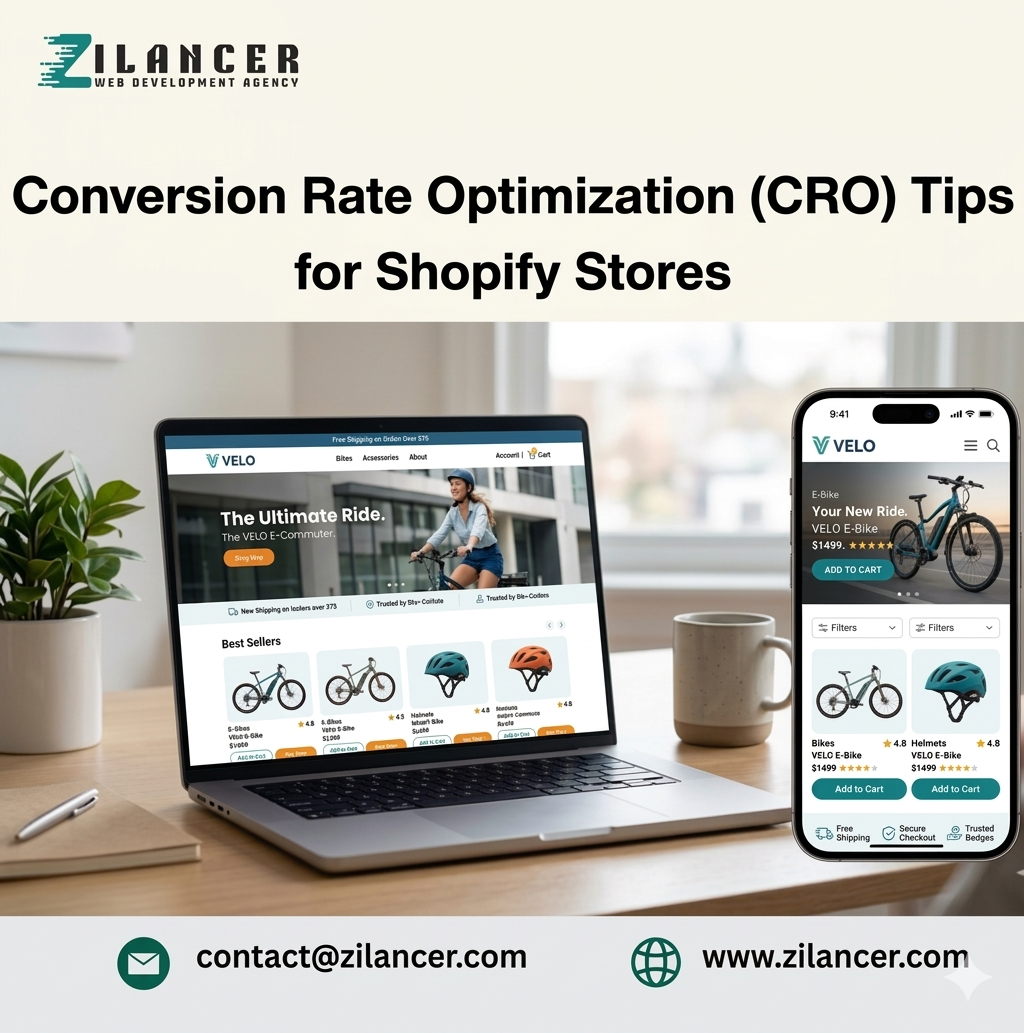
Getting traffic to your Shopify store is important—but converting that traffic into paying customers is what truly drives revenue and long-term success. Many store owners invest heavily in ads, social media marketing, and SEO, yet they often overlook one of the most powerful growth levers: Conversion Rate Optimization (CRO). CRO is the strategic process of improving your store’s user experience so that more visitors take meaningful actions—whether that’s making a purchase, signing up for a newsletter, or adding products to their cart. The beauty of CRO lies in its efficiency. Even a small increase in your conversion rate can lead to a significant boost in revenue without requiring additional advertising spend. At Zilancer, we believe that a high-converting Shopify store is the foundation of every successful eCommerce business. Let’s dive into the most effective CRO strategies that can transform your store into a powerful sales machine.
Optimize Your Website Speed for Maximum Performance
Website speed is one of the most critical factors for achieving maximum performance in any online business, especially for eCommerce and service-based websites. In today’s fast-paced digital environment, users expect a website to load within seconds, and even a slight delay can significantly increase bounce rates and reduce conversions. Optimizing your website speed is not just a technical improvement—it is a direct growth strategy that impacts user experience, SEO rankings, and overall sales performance. One of the most effective ways to improve speed is by optimizing images without compromising quality, using modern formats like WebP and compressing large media files before uploading them. Additionally, minimizing CSS, JavaScript, and unnecessary code helps reduce load time and ensures smoother rendering across all devices. Choosing a high-performance hosting provider is equally important, as server response time plays a major role in how quickly your website loads. Implementing caching mechanisms allows returning visitors to experience faster load times by storing static versions of your pages. Another key factor is reducing third-party scripts, such as excessive tracking codes or unnecessary plugins, which often slow down performance without adding real value. Mobile optimization is also essential because most users now browse through smartphones, and a mobile-optimized, lightweight design ensures better speed and engagement. Tools like Google PageSpeed Insights or GTmetrix can help identify performance issues and provide actionable recommendations for improvement. A fast-loading website not only improves user satisfaction but also boosts SEO rankings, as search engines prioritize speed as a ranking factor. Ultimately, optimizing your website speed creates a smoother user journey, increases trust, reduces bounce rates, and maximizes conversion potential. Businesses that invest in speed optimization gain a competitive advantage by delivering a seamless experience that keeps visitors engaged and encourages them to take action, whether it’s making a purchase, filling out a form, or exploring more pages. Your store’s design plays a critical role in guiding visitors toward making a purchase. A cluttered, overly complex layout can confuse users and push them away, while a clean and structured design keeps them focused on what matters most—your products.
A high-converting Shopify store prioritizes simplicity, clarity, and usability. Clear call-to-action buttons should stand out and guide users naturally through the buying process. Navigation should be intuitive, allowing visitors to find what they need without frustration. Consistent branding builds trust, while a mobile-friendly layout ensures a seamless experience across all devices.
At Zilancer, we create Shopify stores that strike the perfect balance between aesthetics and performance, ensuring that every design element serves a purpose in increasing conversions.
Improve Product Pages to Drive Buying Decisions
Your product page is where the final decision happens. No matter how much traffic you generate, if your product pages fail to convince visitors, your conversion rate will suffer. An effective product page combines high-quality visuals with compelling, benefit-driven content. Clear product images and videos allow customers to visualize what they are buying, while well-written descriptions highlight how the product solves their problems or improves their lives. Adding elements of urgency—such as limited stock availability or countdown timers—can encourage faster decision-making. When your product page answers questions, builds confidence, and creates desire, it removes hesitation and drives conversions. Trust is one of the most important factors in online shopping. Since customers cannot physically interact with your products, they rely heavily on the experiences of others. Social proof, such as customer reviews, testimonials, and user-generated content, reassures potential buyers that your products deliver real value. Trust badges, secure payment icons, and clear guarantees further strengthen credibility and reduce perceived risk. When visitors see that others have had positive experiences with your brand, they feel more confident in making a purchase. Building trust is not optional—it’s essential for increasing conversions. A complicated checkout process is one of the biggest reasons for cart abandonment. Even if a customer is ready to buy, unnecessary friction during checkout can cause them to leave without completing the purchase. A high-converting checkout experience is simple, fast, and user-friendly. Offering guest checkout eliminates the need for account creation, while reducing the number of form fields minimizes effort. Autofill options and multiple payment methods make the process even smoother. The easier it is for customers to complete their purchase, the more likely they are to follow through. Removing friction at this stage can have a dramatic impact on your overall conversion rate. With the majority of eCommerce traffic coming from mobile devices, mobile optimization is no longer optional—it’s a necessity. A poor mobile experience can instantly turn potential customers away. Your Shopify store should be fully responsive, ensuring that it looks and functions perfectly on all screen sizes. Buttons should be easy to tap, text should be readable without zooming, and navigation should be simple and intuitive. A smooth mobile experience not only improves user satisfaction but also significantly increases your chances of converting mobile visitors into customers. Call-to-action buttons are small elements that can have a big impact on your conversion rate. Generic phrases like “Submit” or “Click Here” do not create urgency or excitement. Instead, your CTAs should be action-driven, clear, and persuasive. Phrases like “Buy Now,” “Get Yours Today,” or “Start Your Order” encourage immediate action and make it clear what the customer should do next. The placement, color, and wording of your CTA buttons should all be optimized to capture attention and drive clicks.
Offer Discounts and Incentives to Boost Conversions
Sometimes, customers need an extra push to complete their purchase. Strategic incentives can be highly effective in converting hesitant visitors into buyers. Limited-time discounts create urgency, while free shipping offers reduce friction. Bundle deals increase perceived value, and first-time customer discounts encourage new users to take action. When used correctly, these incentives not only boost conversions but also enhance the overall shopping experience. Not every visitor will convert on their first visit—but that doesn’t mean the opportunity is lost. Exit-intent popups allow you to capture attention at the moment a user is about to leave your site. By offering a discount code, exclusive deal, or email subscription incentive, you can recover potential lost sales and build a valuable customer list. This gives you a second chance to convert those visitors in the future. One of the biggest mistakes in eCommerce is assuming what works best without testing. A/B testing allows you to compare different versions of your store elements and determine what actually drives results. From headlines and product images to CTA buttons and pricing strategies, everything can be tested and optimized. Data-driven decisions eliminate guesswork and ensure continuous improvement. Successful Shopify stores are always evolving—and A/B testing is the key to staying ahead. Not all visitors convert immediately, which is why email marketing plays a crucial role in your CRO strategy. It allows you to nurture leads and bring potential customers back to your store. Abandoned cart emails remind users to complete their purchase, while welcome sequences introduce new subscribers to your brand. Promotional campaigns and personalized product recommendations further encourage engagement and sales. A well-executed email strategy can significantly increase your overall conversion rate and customer lifetime value. Customers often have questions or concerns before making a purchase. If they cannot find answers quickly, they may leave your store and never return. Providing excellent customer support—through live chat, FAQs, and fast response times—helps remove doubts and builds trust. When customers feel supported, they are more confident in completing their purchase.
Why CRO Is a Game-Changer for Shopify Stores
Conversion Rate Optimization (CRO) is a true game-changer for Shopify stores because it focuses on maximizing the value of the traffic you already have, rather than constantly spending more on ads to bring in new visitors. Many store owners invest heavily in Facebook or Google ads but overlook the fact that if their website is not optimized for conversions, a large portion of that traffic is simply wasted. CRO solves this by improving key elements of your store—such as page speed, product pages, trust signals, user experience, and checkout flow—to turn more visitors into paying customers. Even small changes, like clearer product descriptions, better call-to-action buttons, or simplified navigation, can significantly increase conversion rates. This means you can generate more revenue without increasing your marketing budget, which directly improves your return on investment (ROI). For Shopify businesses, CRO is especially powerful because of the competitive nature of eCommerce; customers have endless options, and a slow or confusing website can quickly drive them away. By analyzing user behavior through tools like heatmaps, session recordings, and analytics, you can identify exactly where customers drop off and fix those issues strategically. Over time, this data-driven approach leads to consistent growth, higher customer satisfaction, and stronger brand trust. In simple terms, CRO helps you work smarter, not harder—it ensures that every visitor has a better experience and a higher chance of converting. For any Shopify store aiming to scale sustainably, CRO is not just an option; it’s a necessity. Driving traffic is only half the battle—converting that traffic is where true success begins. By implementing these CRO strategies, you can increase sales, improve customer experience, and build a more profitable Shopify store.Global growth starts with strong conversions. And with the right approach, your Shopify store can become a powerful revenue-generating machine.
If you’re ready to optimize, scale, and succeed, Zilancer is here to help you every step of the way.