






For any e-commerce business, the checkout stage is the most critical point in the entire customer journey. It is the final step where browsing turns into buying and intention becomes revenue. You can have excellent products, strong branding, and high website traffic — but if your checkout experience is flawed, you will lose customers at the most important moment. Many Shopify store owners focus heavily on driving traffic through ads, SEO, and social media marketing. However, they often overlook the checkout process itself. A poorly optimized checkout does not just reduce conversions — it actively pushes customers away and wastes marketing investment. At Zilancer, we frequently audit Shopify stores where traffic numbers look promising, yet revenue does not match expectations. In most cases, the issue is not pricing or product quality — it is friction during checkout.
Why the checkout experience has a Direct Impact on Trust
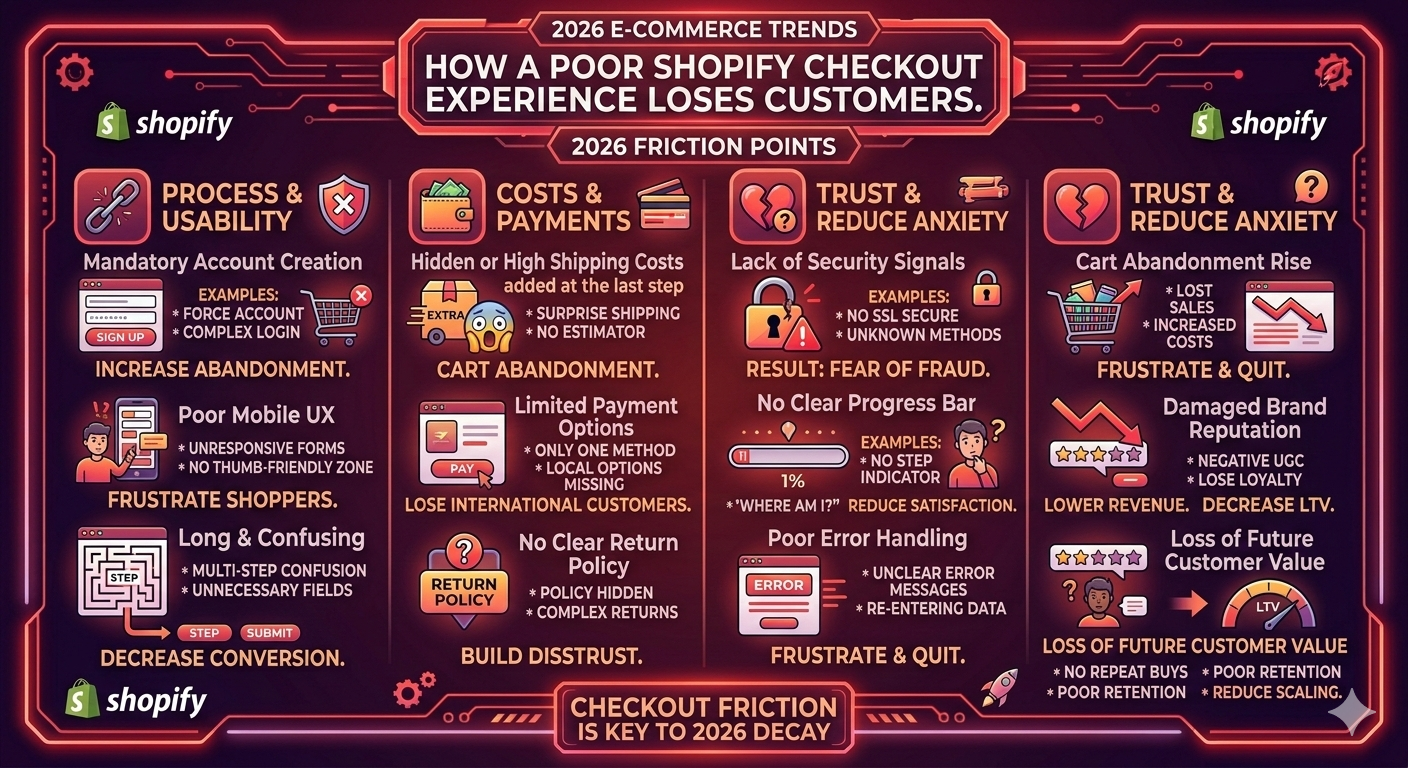
Checkout is the stage where customers are asked to provide personal and financial information. At this point, trust becomes the deciding factor. If the checkout page looks cluttered, outdated, or confusing, users immediately feel uncertain. Online shoppers are cautious. Any delay, unexpected step, or unusual layout can trigger doubt. If customers sense even a small risk, they abandon the process without hesitation. Unlike physical stores, online shoppers can leave instantly with a single tap. A clean, fast, and familiar checkout reassures customers that the store is secure and professional. Shopify users are accustomed to streamlined, intuitive checkout flows. When a store disrupts that expectation, it creates friction — and friction kills conversions. Trust signals such as secure payment icons, recognizable payment gateways, transparent policies, and clear order summaries play a powerful role in reducing anxiety. The smoother the experience feels, the more confident customers become in completing their purchase. Many Shopify stores unintentionally introduce small but costly mistakes into their checkout flow. These issues may seem minor individually, but together they significantly impact conversions. One common problem is lengthy forms with unnecessary fields. When customers are required to fill out too much information, the process feels time-consuming and exhausting. The more effort required, the higher the abandonment rate. Forced account creation is another major conversion killer. First-time buyers often want a quick and simple purchase. Requiring them to create an account interrupts momentum and creates resistance. Offering guest checkout options removes this barrier and encourages faster completion. Slow-loading checkout pages are especially damaging. Customers expect instant responses, particularly on mobile devices. If a page takes too long to load, frustration builds quickly. Unexpected costs are perhaps the most damaging issue. When shipping fees, taxes, or additional charges appear at the final step, customers feel misled. Even if the price increase is small, the sudden surprise breaks trust and causes abandonment. Transparency throughout the purchasing process is essential. Complicated discount code entry, unclear error messages, and poorly positioned buttons can also create confusion and delay decision-making. Every abandoned checkout represents lost revenue that was nearly secured. At this stage, customers have already shown strong purchase intent — they selected products, added them to their cart, and initiated checkout. Losing them at the final step is one of the most expensive mistakes a store can make. Poor checkout performance increases customer acquisition costs. Businesses must spend more on advertising to replace lost conversions. Over time, this reduces profit margins and slows overall growth. Checkout optimization, on the other hand, often delivers immediate and measurable improvements. Small adjustments — such as reducing form fields, improving page speed, or simplifying layout — can dramatically increase completion rates. For many Shopify brands, optimizing checkout offers one of the highest returns on investment compared to other marketing efforts. Today, a large portion of Shopify traffic comes from mobile users. Mobile checkout behavior is fast-paced and unforgiving. Small screens, touch navigation, and shorter attention spans mean that checkout must be extremely simple. If input fields are hard to tap, text is difficult to read, or pages load slowly, mobile users abandon instantly. Long scrolling forms feel overwhelming on small devices. Mobile-first checkout optimization focuses on clear buttons, autofill features, express payment options, and minimal steps. Payment solutions such as Shop Pay, Apple Pay, or Google Pay significantly reduce friction by allowing customers to complete purchases in seconds. Because mobile traffic volume is high, even small mobile improvements can generate significant revenue growth.
The Psychological Impact of a Smooth Checkout
A well-designed checkout does more than complete transactions — it reinforces brand credibility. When customers experience a seamless checkout process, they associate your brand with efficiency and professionalism. This positive experience increases the likelihood of repeat purchases. Customers are more willing to return to a store where the buying process felt easy and secure. On the other hand, a frustrating checkout creates negative impressions that are difficult to reverse. Even if customers eventually complete the purchase, they may hesitate to return in the future. Checkout is not just a technical process — it is part of your brand experience. At Zilancer, we approach checkout optimization strategically and based on real user data. We analyze customer behavior to identify drop-off points and friction areas. Heatmaps, analytics, and conversion tracking help us understand exactly where users hesitate or exit. We then simplify the flow, reduce unnecessary steps, improve mobile usability, and ensure transparent pricing. Our focus is to make checkout feel effortless, secure, and intuitive — while maintaining brand consistency. By combining user experience design with performance optimization, we transform checkout from a weak point into a powerful conversion engine. A poor Shopify checkout experience silently drains revenue every single day. It wastes advertising budgets, increases acquisition costs, and turns ready-to-buy customers into lost opportunities. However, checkout friction is fixable. By prioritizing simplicity, speed, transparency, and mobile usability, Shopify brands can significantly improve conversion rates and profitability. In eCommerce, the smallest improvements at checkout often create the biggest impact on revenue. Optimize the final step, and you strengthen the entire business.