





Running a Shopify store successfully is no longer only about driving traffic. Thousands of Shopify businesses invest heavily in Facebook ads, Google ads, influencer marketing, SEO campaigns, and social media promotions every single day. Yet many store owners still struggle to generate consistent sales and profitable growth. The reason behind this problem is often not traffic generation. The real issue is conversion rate optimization. Conversion rate optimization, also known as CRO, is the process of improving your Shopify store so that more visitors become paying customers. A well-optimized Shopify store can dramatically increase revenue without increasing advertising costs. This means businesses can generate more profit from the same amount of traffic simply by improving the customer experience and removing friction from the buying process. Successful eCommerce brands understand that small improvements can create massive results. Faster loading pages, better product presentation, simplified navigation, improved checkout experiences, mobile optimization, trust-building elements, and strategic upselling systems all contribute to higher conversion rates. When combined correctly, these strategies can transform an average Shopify store into a high-performing sales machine.
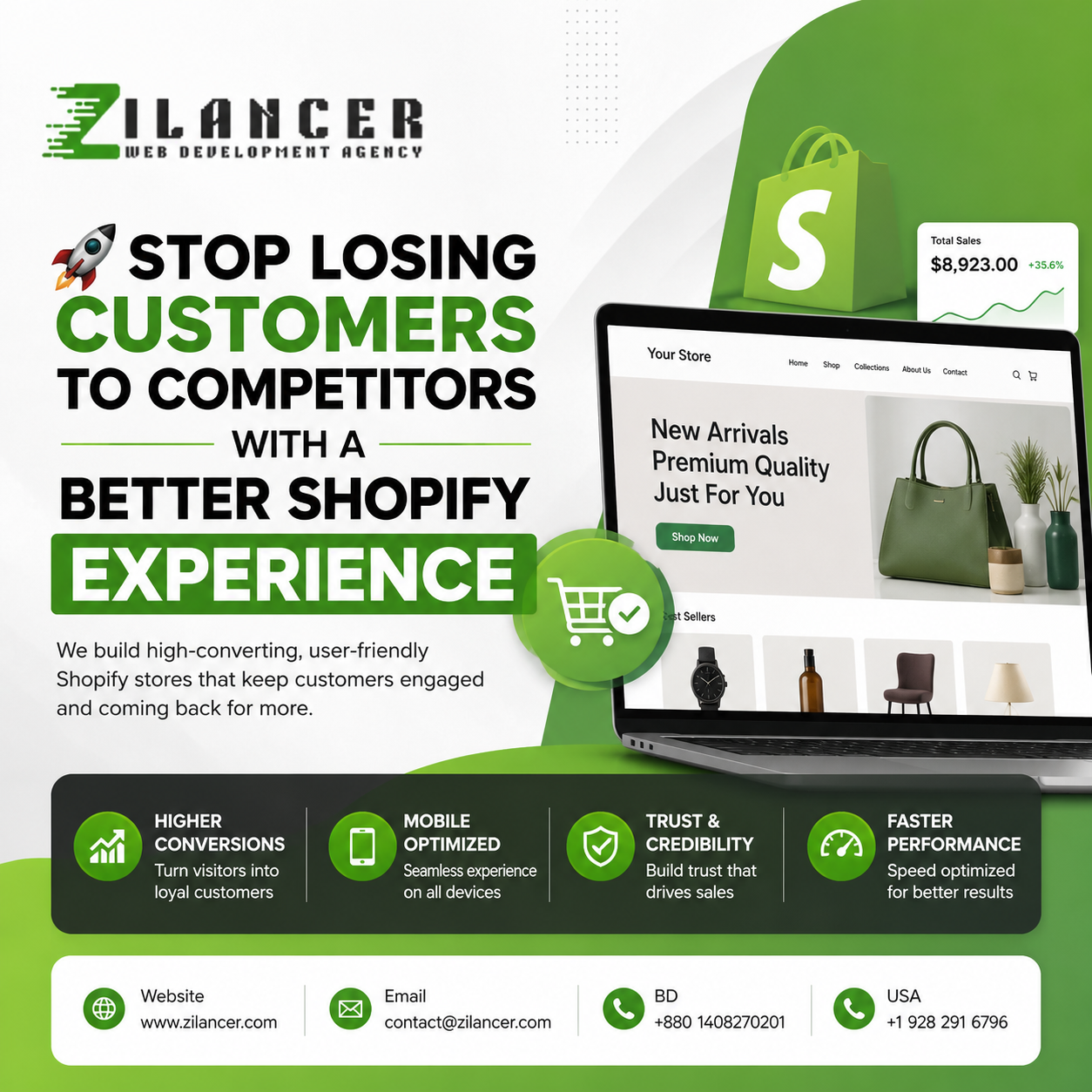
At Zilancer, we specialize in helping Shopify businesses improve conversion rates through modern design, strategic optimization, performance improvements, and advanced Shopify solutions. Our agency focuses on creating Shopify experiences that not only look beautiful but also drive measurable business growth.
Understanding Shopify Conversion Rate Optimization
Shopify Conversion Rate Optimization, often called CRO, is the structured process of improving your online store so that a higher percentage of visitors complete a purchase. In simple terms, it is not about bringing more traffic to your store, but about making better use of the traffic you already have. When done correctly, CRO turns passive visitors into paying customers by improving every step of their shopping journey. In the world of eCommerce, most Shopify store owners focus heavily on marketing strategies such as paid ads, influencer campaigns, and SEO. While these methods are important for generating traffic, they do not guarantee sales. Many stores receive thousands of visitors every month but still struggle with low revenue because their store is not optimized for conversions. This is where CRO becomes essential. Conversion rate optimization begins with understanding customer behavior. Every visitor who lands on your Shopify store goes through a decision-making process. They first form an impression within seconds based on your design, loading speed, and branding. Then they evaluate your product pages, pricing, trust signals, and overall usability before deciding whether to stay or leave. CRO focuses on removing friction from this journey and guiding users smoothly toward checkout.
A well-optimized Shopify store creates clarity at every stage. It ensures that customers can easily find products, understand their value, trust the brand, and complete their purchase without confusion or hesitation. Small improvements in design, layout, messaging, and performance can significantly increase conversion rates over time. For example, improving page speed can reduce bounce rates because customers are less likely to abandon a slow-loading site. Enhancing product descriptions can increase purchase confidence by clearly explaining benefits and solving customer pain points. Adding trust elements such as reviews, secure payment icons, and return policies can reduce hesitation and build credibility. Even simplifying the checkout process can directly increase completed orders. Conversion optimization is also closely tied to user experience. If a Shopify store feels complicated to navigate, customers will leave before making a purchase. On the other hand, a clean, intuitive, and mobile-friendly design encourages users to explore more products and proceed toward checkout naturally. Since most Shopify traffic now comes from mobile devices, mobile optimization plays a critical role in CRO success.
Another important aspect of CRO is continuous testing and improvement. Successful Shopify businesses do not rely on assumptions. Instead, they analyze real user data, track behavior through analytics tools, and run A/B tests to identify what works best. This data-driven approach ensures that every change made to the store contributes to better performance and higher revenue. At Zilancer, Shopify Conversion Rate Optimization is approached as a complete growth system rather than a one-time improvement task. The focus is on combining design psychology, technical performance, user experience, and strategic optimization to build Shopify stores that consistently convert visitors into customers. By analyzing customer behavior and applying proven CRO strategies, we help businesses unlock the full revenue potential of their existing traffic. Ultimately, Shopify CRO is about understanding people. It is about knowing how customers think, what they need to feel confident, and what prevents them from completing a purchase. When these barriers are removed, conversion rates naturally increase, and Shopify stores become more profitable without increasing advertising costs.
Why Shopify Conversion Rate Optimization Matters
Shopify Conversion Rate Optimization matters because it directly impacts how much revenue your store generates from the traffic you already have. In eCommerce, many businesses focus heavily on bringing more visitors through ads, SEO, and social media marketing, but they often overlook what happens after those visitors arrive. CRO ensures that every visit has the highest possible chance of turning into a sale. The biggest reason CRO is so important is efficiency. Instead of spending more money to attract new customers, you improve the performance of your existing store. Even a small increase in conversion rate can lead to a significant boost in revenue. For example, if your store converts at a low rate, most of your traffic is being wasted. But when you optimize your store properly, the same number of visitors can generate multiple times more sales without increasing your marketing budget. Another important factor is customer behavior. Online shoppers are highly sensitive to experience, trust, and convenience. If your Shopify store is slow, confusing, or difficult to navigate, visitors will leave quickly without buying anything. On the other hand, a well-optimized store builds confidence and guides users smoothly toward checkout. CRO focuses on removing every possible barrier that stops customers from completing a purchase.
Trust plays a major role in this process. Customers are more likely to buy from stores that look professional, load quickly, and clearly communicate value. Elements such as product reviews, clear return policies, secure checkout signals, and high-quality visuals all contribute to trust. Without these elements, even interested customers may hesitate to complete their purchase. CRO ensures that trust is built at every stage of the shopping journey. Mobile performance is another critical reason why CRO matters. Most Shopify traffic today comes from mobile devices, and mobile users expect fast, simple, and frictionless experiences. If your mobile store is not optimized properly, you risk losing a large portion of potential customers. CRO improves mobile usability by simplifying navigation, optimizing layouts, and making checkout processes easier on smaller screens. Conversion rate optimization also helps reduce cart abandonment, which is one of the biggest challenges in eCommerce. Many customers add products to their cart but leave before completing checkout due to unexpected costs, complicated forms, or lack of trust. CRO identifies these issues and fixes them through better UX design, transparent pricing, and simplified checkout flows.
Data-driven decision-making is another key reason CRO matters. Instead of guessing what might work, successful Shopify businesses rely on analytics, heatmaps, and A/B testing to understand real user behavior. This allows store owners to make informed improvements that actually increase conversions rather than relying on assumptions. At Zilancer, we treat Shopify Conversion Rate Optimization as a core growth strategy rather than a secondary task. Our approach focuses on improving every part of the customer journey, from landing page experience to final checkout. By combining design improvements, performance optimization, and user behavior analysis, we help Shopify businesses increase revenue without increasing ad spend. Ultimately, CRO matters because traffic alone is not enough. A Shopify store only becomes successful when visitors are converted into paying customers efficiently. By improving conversion rates, businesses unlock more value from their existing audience, reduce wasted marketing spend, and build a more sustainable and profitable eCommerce system.
Improve Shopify Store Speed for Better Conversions
Improving Shopify store speed is one of the most impactful conversion rate optimization strategies because speed directly influences how customers behave on your website. In today’s fast-paced digital environment, users expect instant loading experiences. Even a slight delay can cause frustration, reduce trust, and lead to immediate drop-offs before a customer even views your products. Store speed affects every stage of the customer journey. From the moment a visitor lands on your homepage to the final checkout step, performance plays a critical role in whether they stay engaged or leave. A slow Shopify store creates friction, while a fast store delivers a smooth and seamless shopping experience that naturally encourages users to explore more products and complete their purchase. One of the most important reasons speed matters is its direct impact on bounce rate. When pages take too long to load, visitors often abandon the site without interacting at all. This means you lose potential customers before they even get a chance to see what you offer. Faster loading times help keep users engaged, increasing the likelihood that they will browse products, add items to cart, and move toward checkout.
Speed also plays a major role in building trust. A slow and unresponsive website often feels unprofessional or unreliable to customers. On the other hand, a fast and responsive Shopify store gives the impression of a well-optimized, credible brand. This psychological factor significantly increases customer confidence, especially for first-time visitors who are not familiar with your business. Mobile performance is especially critical because most Shopify traffic comes from smartphones. Mobile users are even more sensitive to speed issues due to varying network conditions and device limitations. A mobile-optimized, fast-loading Shopify store ensures that customers can browse smoothly, view product pages without delay, and complete purchases without frustration. If your mobile experience is slow, you are likely losing a large portion of potential revenue. Improving Shopify store speed involves multiple optimization layers. Image optimization is one of the most important factors because large, uncompressed images can significantly slow down page loading times. Reducing image sizes without losing quality helps improve performance dramatically. Similarly, removing unnecessary apps and scripts reduces backend load and improves responsiveness across the entire store.
Theme optimization also plays a key role in speed improvement. Lightweight, well-coded Shopify themes perform much better than heavy, overly complex designs. Clean coding practices, minimal scripts, and optimized layout structures ensure faster rendering times and smoother user interactions. Another critical area is reducing third-party script usage. Many Shopify stores rely on multiple apps for functionality, but each added script can slow down performance. Careful selection and optimization of apps help maintain a balance between functionality and speed. Caching and content delivery networks also contribute to faster load times by serving content more efficiently to users based on their location. This reduces latency and ensures a consistent experience for visitors across different regions. At Zilancer, Shopify store speed optimization is treated as a core part of conversion rate improvement. Our approach focuses on identifying performance bottlenecks, optimizing store assets, streamlining code, and ensuring that every Shopify store runs at peak performance across all devices. The goal is not just faster loading times, but a smoother user experience that directly increases conversions and revenue. Ultimately, improving Shopify store speed is not just a technical enhancement. It is a direct investment in customer experience and business growth. A faster store keeps users engaged, builds trust, reduces bounce rates, and significantly increases the chances of turning visitors into paying customers.
Mobile Optimization is Essential for Shopify Success
Mobile optimization is no longer optional for Shopify stores; it is a fundamental requirement for success in modern eCommerce. The majority of online shoppers now use mobile devices to browse products, compare prices, and make purchases. This shift in user behavior means that a Shopify store that is not fully optimized for mobile will inevitably lose a significant portion of its potential revenue. When customers visit a Shopify store on mobile, their expectations are very specific. They want pages that load quickly, layouts that adjust perfectly to their screen size, and navigation that feels simple and intuitive. If any of these elements fail, users are likely to abandon the store within seconds. Mobile users are less patient than desktop users, making performance and usability even more critical.
Mobile optimization directly affects conversion rates because it shapes the entire shopping experience. A poorly optimized mobile store often has issues such as overlapping elements, hard-to-read text, slow-loading product pages, and complicated checkout flows. These problems create friction, which reduces trust and discourages users from completing their purchase. On the other hand, a well-optimized mobile store feels smooth, fast, and effortless, guiding users naturally toward checkout. User experience plays a central role in mobile conversion optimization. On smaller screens, clarity becomes extremely important. Customers should be able to find products easily, view images clearly, read product descriptions comfortably, and interact with buttons without difficulty. Every element of the design must be simplified and structured to support mobile browsing behavior. Navigation is one of the most important aspects of mobile optimization. A clean and minimal navigation system helps users move through the store without confusion. Dropdown menus, search functionality, and product filtering must be optimized for touch interactions. If users struggle to find what they are looking for, they are far more likely to leave the site without purchasing.
Mobile checkout optimization is equally critical. Many Shopify stores lose customers during checkout because the process is too long or not properly optimized for mobile devices. Forms should be short, easy to complete, and fully responsive. Payment options should be clearly visible and easy to select. Any unnecessary steps in the checkout process increase the risk of cart abandonment. Page speed also plays a major role in mobile performance. Mobile users often browse on slower networks compared to desktop users, so even minor performance issues can create noticeable delays. Optimizing images, reducing unnecessary scripts, and using lightweight themes can significantly improve mobile loading times and overall user satisfaction. Another important factor in mobile optimization is visual hierarchy. Content must be structured in a way that naturally guides the user’s attention. Product images should be clear and properly sized, headlines should be readable without zooming, and call-to-action buttons should be easily accessible. A strong visual hierarchy ensures that users can make decisions quickly and confidently.
Trust is also essential on mobile devices. Since users cannot physically interact with products, they rely heavily on visual cues and credibility signals. Reviews, ratings, secure payment icons, and clear return policies must be prominently displayed and easy to view on mobile screens. Without these trust elements, conversion rates can drop significantly. At Zilancer, mobile optimization is a core part of our Shopify conversion strategy. We design and optimize Shopify stores with a mobile-first approach, ensuring that every element is tailored for mobile users. From layout design and speed optimization to checkout improvements and user experience enhancements, our goal is to create seamless mobile shopping journeys that maximize conversions and revenue. Ultimately, mobile optimization is essential because it directly determines how effectively your Shopify store performs in real-world conditions. A mobile-friendly store increases engagement, reduces friction, builds trust, and significantly improves conversion rates, making it one of the most powerful drivers of Shopify success.
Improve Shopify SEO for Higher Quality Traffic
Improving Shopify SEO is one of the most powerful ways to increase conversion rates because it brings in highly targeted visitors who are already searching for your products or solutions. Unlike paid ads that push your store in front of broad audiences, SEO attracts users with clear intent, meaning they are more likely to engage, trust your brand, and complete a purchase. This makes SEO not just a traffic strategy, but a direct contributor to conversion rate optimization. Search engine optimization for Shopify goes beyond ranking on Google. It is about attracting the right customers at the right stage of their buying journey. When your store appears in search results for relevant keywords, it builds instant credibility and positions your brand as a trusted solution. Customers often perceive organic search results as more reliable than ads, which increases the likelihood of clicks and conversions. High-quality traffic is one of the most important benefits of Shopify SEO. Not all visitors are equal, and random traffic rarely converts well. SEO ensures that people landing on your store already have interest or intent related to your products. For example, a user searching for a specific product type is far more likely to buy than someone who discovers your store through unrelated advertising. This alignment between intent and offering is what makes SEO such a strong CRO strategy.
On-page optimization plays a major role in improving Shopify SEO performance. Product titles, descriptions, meta tags, and structured content all help search engines understand your store better. At the same time, well-written and optimized content helps customers make informed decisions. When product pages clearly explain benefits, features, and use cases, users feel more confident about purchasing, which directly improves conversion rates. Content quality is another critical factor. Shopify stores that publish helpful, informative, and keyword-focused content tend to perform better in search rankings and user engagement. Blog posts, guides, and landing pages can attract users at different stages of the buying journey. Educational content builds trust and authority, making customers more comfortable with purchasing from your brand. Technical SEO is equally important for both rankings and conversions. A well-structured Shopify store with clean code, fast loading speed, mobile optimization, and proper indexing ensures that search engines can easily crawl and rank your pages. At the same time, these technical improvements enhance user experience, reduce bounce rates, and increase the chances of conversion. SEO and CRO are deeply connected because both rely on performance, structure, and usability. Internal linking also improves both SEO and user navigation. When users can easily move between related products, collections, and informational pages, they spend more time on your store and explore more options. This increases engagement and helps guide customers toward purchase decisions naturally.
Another important aspect of Shopify SEO is keyword targeting. Understanding what your customers are searching for allows you to create content that matches their intent. When your store aligns with customer search behavior, it becomes easier to attract qualified traffic that is more likely to convert. At Zilancer, Shopify SEO is integrated with conversion rate optimization strategies to ensure that traffic is not only increased but also highly profitable. Our approach focuses on optimizing product pages, improving site structure, enhancing content strategy, and aligning SEO efforts with user behavior and conversion goals. This combination ensures that every visitor arriving from search engines has a higher chance of becoming a customer. Ultimately, Shopify SEO matters because it brings in the right audience, improves brand visibility, and supports long-term business growth. When combined with strong conversion rate optimization strategies, SEO becomes a sustainable system for generating consistent traffic and increasing revenue without relying solely on paid advertising.
Why Businesses Choose Zilancer for Shopify CRO Services
Businesses choose Shopify Conversion Rate Optimization services when they realize that traffic alone is not enough to grow revenue. Many Shopify store owners invest heavily in ads, SEO, and social media marketing, but still struggle to achieve consistent sales. The missing piece is often a properly optimized conversion system that turns visitors into paying customers. This is where expert CRO services become essential, and where experienced Shopify agencies like Zilancer play a critical role in business growth. One of the main reasons businesses choose Zilancer is the focus on results rather than just design. Many agencies create visually attractive Shopify stores, but aesthetics alone do not guarantee conversions. Zilancer approaches Shopify development and optimization with a performance-first mindset. Every design decision, layout structure, and user experience element is built to increase sales and improve customer behavior on the store.
Another important reason is the deep understanding of customer psychology. Conversion rate optimization is not just technical work; it is also about understanding how users think, what builds trust, and what causes hesitation during the buying journey. Zilancer applies proven CRO principles such as trust-building design, persuasive product presentation, simplified navigation, and friction-free checkout experiences to increase conversion rates effectively. Speed and performance optimization are other key factor that makes Zilancer a preferred choice. A slow Shopify store can significantly reduce conversions, no matter how good the products are. Zilancer focuses on improving loading speed, optimizing images, reducing unnecessary scripts, and ensuring that stores perform smoothly across all devices. Faster stores create better user experiences and directly lead to higher sales. Mobile-first optimization is also a major strength. Since most Shopify traffic comes from mobile devices, businesses need stores that are fully responsive and easy to use on smaller screens. Zilancer ensures that every Shopify store is designed and optimized for mobile users, with clean layouts, readable content, and smooth checkout experiences that reduce friction and increase purchase completion rates.
Another reason businesses choose Zilancer is the focus on data-driven decision-making. Instead of relying on guesswork, CRO strategies are built using analytics, user behavior tracking, and performance insights. This allows continuous improvement based on real customer data, ensuring that every optimization step contributes to measurable growth. Zilancer also specializes in building high-converting Shopify product pages and layouts. Product pages are one of the most important conversion points in any online store. By improving product descriptions, visuals, trust signals, and call-to-action placement, Zilancer helps businesses increase customer confidence and boost sales performance. Checkout optimization is another area where many Shopify stores lose potential revenue. Zilancer works on simplifying checkout flows, reducing unnecessary steps, and improving payment experiences to minimize cart abandonment and maximize completed purchases. Small improvements in checkout design can lead to significant revenue increases over time.
Businesses also value Zilancer for its complete Shopify ecosystem approach. Instead of focusing on just one part of the store, the entire customer journey is optimized. From landing pages and homepage structure to product discovery, user experience, and post-purchase engagement, every stage is designed to improve conversion performance. At its core, Zilancer helps Shopify businesses unlock the full potential of their existing traffic. Instead of spending more money on advertising to attract new visitors, businesses can increase revenue by improving how effectively their store converts current visitors into customers. This makes CRO one of the most cost-effective growth strategies in eCommerce. Ultimately, businesses choose Zilancer because it delivers more than just Shopify design or development. It delivers a complete conversion-focused growth system that combines strategy, design, performance, and optimization to help brands scale faster and generate more revenue sustainably.
Shopify conversion rate optimization is one of the most effective ways to increase sales, improve profitability, and maximize the value of your traffic. Businesses that focus only on traffic generation without optimizing customer experience often waste significant growth opportunities. A successful Shopify store requires much more than an attractive design. It needs speed optimization, mobile responsiveness, trust-building strategies, conversion-focused layouts, optimized product pages, seamless checkout experiences, strategic upselling systems, and data-driven improvements. Every element of your Shopify store influences customer decisions. Small improvements across multiple areas can create massive revenue growth over time. If you want to transform your Shopify store into a high-converting eCommerce business, partnering with experienced Shopify experts can make a significant difference.
At Zilancer, we help businesses build powerful Shopify experiences designed for growth, conversions, and long-term success.