







The Shopify ecosystem has transformed the way businesses sell online. With its flexibility, scalability, and extensive app marketplace, Shopify empowers entrepreneurs and established brands alike to build powerful eCommerce stores capable of reaching customers worldwide. However, while Shopify provides an exceptional foundation, simply launching a store does not guarantee success. Every day, thousands of Shopify merchants invest heavily in advertising, social media marketing, email campaigns, influencer partnerships, and SEO strategies to drive traffic to their websites. Yet many of these businesses struggle to achieve the sales results they expect. Store owners often assume the issue lies with their marketing campaigns when, in reality, the real problem exists inside the store itself.
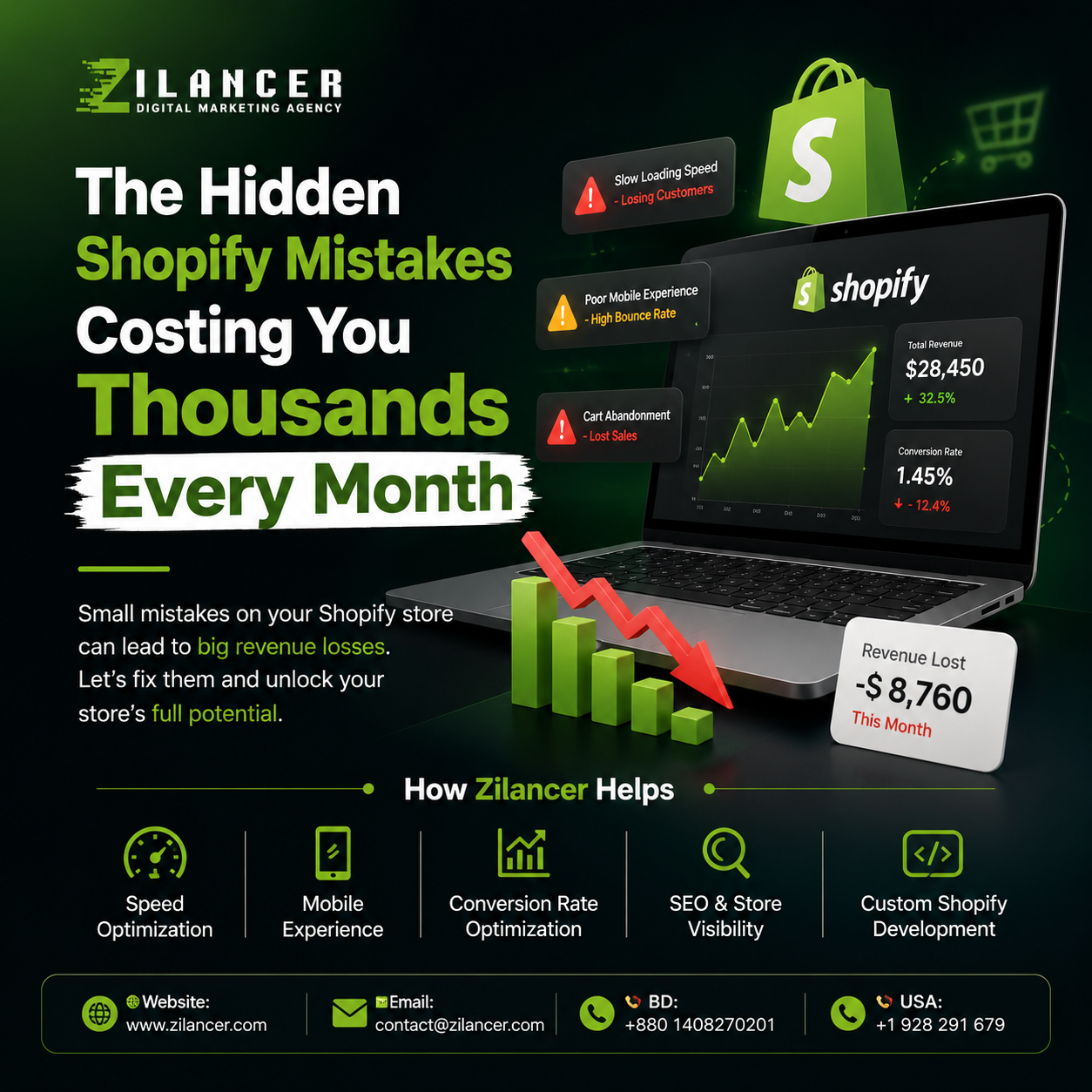
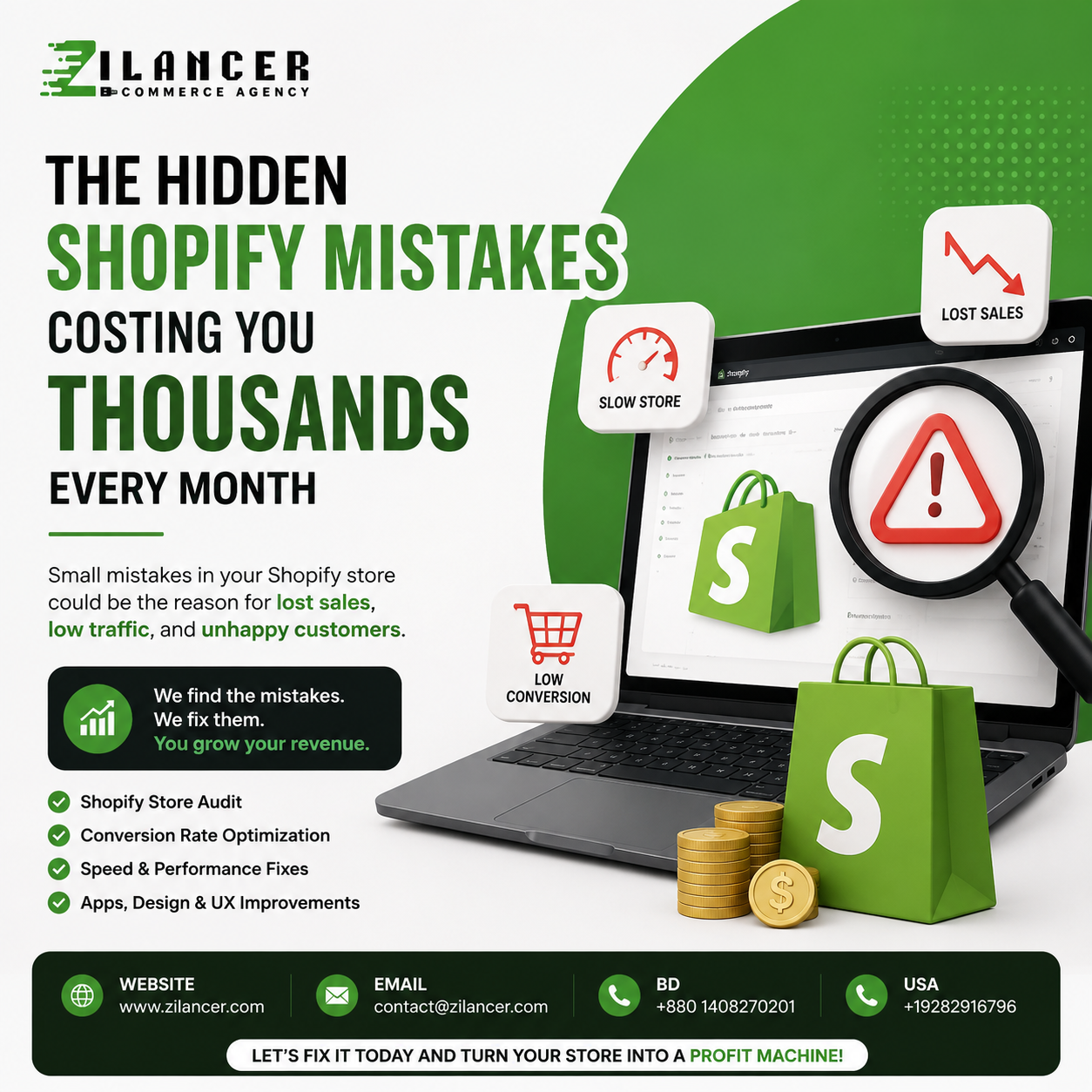
The most expensive mistakes are often the ones you cannot immediately see. Small conversion barriers, technical inefficiencies, poor user experiences, and outdated store structures silently reduce sales opportunities. These issues rarely trigger obvious warnings, but over time they can cost businesses thousands of dollars every month in lost revenue. A visitor arrives on your store. They browse products, show interest, and even add items to their cart. But somewhere along the journey, friction appears. Maybe the page loads too slowly. Perhaps product information feels incomplete. The mobile experience may be frustrating. Checkout could require unnecessary effort. Whatever the cause, the customer leaves without purchasing. When this happens repeatedly, the revenue loss becomes enormous.
Understanding these hidden Shopify mistakes is essential for sustainable eCommerce growth. More importantly, knowing how to fix them can dramatically improve conversion rates, customer satisfaction, and profitability.
Why Small Shopify Mistakes Create Massive Revenue Losses
Many Shopify store owners assume that significant revenue losses are caused by major issues such as poor products, ineffective marketing campaigns, or insufficient website traffic. While these factors can certainly impact business performance, the reality is often far more surprising. In many cases, it is the small and seemingly insignificant mistakes throughout a Shopify store that silently drain revenue every single day. The danger of these minor issues lies in their ability to go unnoticed. A slow-loading product page may only cause a few visitors to leave. A confusing navigation menu may frustrate a handful of shoppers. An unclear call-to-action button may reduce conversions by a small percentage. Individually, these problems may appear harmless. However, when combined across hundreds or thousands of monthly visitors, the financial impact becomes substantial.
Imagine a Shopify store receiving 50,000 visitors per month. If just 2% of those visitors abandon the website because pages load too slowly, the business could lose 1,000 potential customers before they even view a product. If another percentage of visitors leave because the mobile experience is difficult to use, and another group abandons their carts due to checkout friction, the store could be missing out on thousands of dollars in revenue every month without realizing it. One of the most common misconceptions among eCommerce merchants is that increasing traffic will automatically increase sales. As a result, many businesses continuously invest more money into Facebook Ads, Google Ads, influencer marketing, and email campaigns while ignoring the performance of the store itself. This approach often creates a costly cycle where businesses spend more to acquire visitors but fail to maximize the value of the traffic they already have.
A Shopify store can be compared to a bucket filled with water. Marketing efforts pour more water into the bucket, but hidden conversion issues create holes that allow revenue to leak out. No matter how much traffic is generated, growth remains limited if those leaks are not addressed. Successful eCommerce brands understand that optimizing the customer experience is often more profitable than simply increasing visitor numbers. Website speed provides a perfect example of how a small issue can create massive losses. Research consistently shows that users expect websites to load almost instantly. Even a delay of a few seconds can significantly increase bounce rates and reduce conversions. Many Shopify stores unknowingly suffer from oversized images, excessive third-party apps, poorly optimized themes, and unnecessary scripts that slow down performance. Every second of delay increases the likelihood that potential customers will leave and purchase from a competitor instead. Mobile optimization presents another critical challenge. Today, the majority of online shoppers browse and purchase products using smartphones and tablets. Yet many Shopify stores are still designed primarily with desktop users in mind. Small mobile usability issues such as difficult navigation, poorly sized buttons, cluttered layouts, or slow-loading images can dramatically reduce conversion rates. Since mobile traffic often represents the largest segment of visitors, even minor mobile experience problems can translate into significant monthly revenue losses.
Product pages also play a crucial role in determining whether visitors become customers. Many merchants underestimate the importance of detailed product information, high-quality visuals, persuasive copywriting, and trust-building elements. A visitor may be interested in purchasing a product, but uncertainty can quickly lead to hesitation. Missing information, weak descriptions, low-quality images, or lack of customer reviews can prevent shoppers from completing their purchase. Every abandoned buying decision represents lost revenue that could have been captured through better optimization. Checkout friction is another hidden revenue killer that often goes unnoticed. By the time a customer reaches the checkout page, they have already demonstrated strong buying intent. Unfortunately, many Shopify stores introduce unnecessary barriers during the final stages of the purchasing journey. Unexpected shipping costs, lengthy forms, forced account creation, limited payment options, and unclear trust signals can all contribute to cart abandonment. Even a slight increase in checkout completion rates can result in substantial revenue growth over time. Another overlooked factor is app overload. Shopify’s extensive app ecosystem allows merchants to add functionality quickly, but excessive app installations often create performance problems. Many store owners install multiple apps over the years without removing outdated or unused ones. These apps add extra code, increase page load times, and can create technical conflicts that negatively affect user experience. What appears to be a minor technical issue behind the scenes may ultimately cost a business thousands of dollars in lost conversions.
The financial impact becomes even greater when these issues compound over time. A store losing just a few sales each day due to hidden conversion barriers may miss hundreds of sales every month and thousands of sales every year. As customer acquisition costs continue to rise, maximizing conversion efficiency becomes more important than ever. Every visitor who leaves without purchasing represents money already spent on marketing that fails to generate a return. This is why leading eCommerce brands prioritize continuous optimization. They regularly audit their Shopify stores, analyze customer behavior, identify friction points, and implement improvements designed to increase conversions. Rather than focusing solely on acquiring more traffic, they work to ensure that every visitor has the highest possible chance of becoming a customer. At Zilancer, we help Shopify merchants uncover these hidden revenue leaks before they become major business obstacles. Our Shopify experts conduct in-depth performance audits, conversion rate optimization analysis, user experience evaluations, speed optimization projects, and technical improvements that help businesses maximize the value of every visitor. By identifying and correcting the small mistakes that often go unnoticed, we help brands transform underperforming stores into powerful revenue-generating assets.
The truth is that massive revenue losses rarely occur because of a single catastrophic problem. More often, they result from dozens of small mistakes working together to reduce conversions, damage customer experience, and limit growth. Identifying and fixing these issues can unlock significant revenue opportunities and create a stronger foundation for long-term eCommerce success.
Slow Store Speed Is Destroying Your Conversions
In today’s highly competitive eCommerce landscape, speed is no longer a luxury—it is a necessity. Shopify store owners invest significant resources into attracting visitors through paid advertising, search engine optimization, email marketing, and social media campaigns. However, many fail to realize that even the most effective marketing strategy can become ineffective if the website itself is slow. Every second of delay between a customer’s click and the page loading can have a direct impact on user experience, engagement, and ultimately, sales. Modern online shoppers expect websites to load almost instantly. Consumers have become accustomed to fast digital experiences across every platform they use. Whether browsing social media, streaming videos, or shopping online, users demand speed and convenience. When a Shopify store fails to meet these expectations, visitors often leave before they even have a chance to explore products. In many cases, they do not return.
Store speed influences every stage of the customer journey. It affects first impressions, browsing behavior, product discovery, checkout completion, and customer satisfaction. A slow-loading homepage can increase bounce rates. Delayed product pages can reduce engagement. Sluggish cart and checkout experiences can cause customers to abandon purchases at the final stage. The result is a significant reduction in conversions and revenue. Many Shopify merchants underestimate the financial impact of website speed. They may notice declining sales or poor advertising performance without realizing that page load times are contributing to the problem. Even a small delay can have a measurable effect on conversion rates. When multiplied across thousands of monthly visitors, these lost opportunities can quickly add up to thousands of dollars in missed revenue. One of the reasons speed has such a powerful impact on conversions is that it directly affects user trust. Customers subconsciously associate website performance with business professionalism. When a store loads slowly, visitors may question the reliability of the business, the quality of its products, or the security of the checkout process. A fast website creates confidence, while a slow website creates doubt.
Mobile users are particularly sensitive to performance issues. Today, the majority of Shopify traffic comes from smartphones and tablets. Mobile shoppers are often browsing while multitasking, commuting, or comparing products from multiple stores. Their patience is extremely limited. If a page takes too long to load, they can easily leave and find a competitor offering a faster experience. This makes mobile speed optimization one of the most important factors influencing modern eCommerce success. Several hidden issues commonly contribute to poor Shopify performance. Large uncompressed images are among the most frequent causes of slow loading times. High-resolution product photos may look impressive, but if they are not properly optimized, they can dramatically increase page weight and slow down loading speeds. Every image on a Shopify store should be compressed and optimized without sacrificing visual quality.
Another major issue is excessive app installations. Shopify’s app ecosystem offers tremendous flexibility, allowing merchants to add new functionality with just a few clicks. However, every app introduces additional scripts, code, and resources that must load when visitors access the website. Over time, many stores accumulate unnecessary apps that continue consuming resources even if they are rarely used. This app overload creates performance bottlenecks that negatively affect the customer experience. Poorly optimized themes can also contribute to slow store speed. Many merchants purchase themes based solely on visual appearance without considering performance. Some themes contain excessive animations, unnecessary design elements, bloated code structures, and inefficient scripts that slow down every page. While a visually attractive store is important, design should never come at the expense of usability and speed. Third-party integrations are another hidden source of performance problems. Marketing pixels, tracking tools, live chat software, review widgets, analytics platforms, and advertising scripts all add functionality to a Shopify store. However, when too many external resources are loaded simultaneously, page speed suffers. Without proper optimization, these tools can create significant delays that hurt conversions.
Store speed also plays a critical role in search engine optimization. Google prioritizes user experience and considers website performance when determining rankings. A slow Shopify store may struggle to achieve strong visibility in search results, making it more difficult to attract organic traffic. Faster websites generally provide better user experiences, lower bounce rates, and stronger engagement metrics, all of which can positively influence SEO performance. Customer expectations continue to rise as eCommerce technology evolves. Shoppers no longer compare your store solely against direct competitors. Instead, they compare your experience against industry leaders such as Amazon and other high-performance online retailers. If your Shopify store feels slow compared to the websites customers use daily, conversion opportunities can quickly disappear. The impact of speed extends beyond the initial sale. Faster websites create smoother shopping experiences, which improves customer satisfaction and encourages repeat purchases. Returning customers are often more profitable than new customers because they require lower acquisition costs and typically have higher lifetime value. By improving store speed, businesses not only increase immediate conversions but also strengthen long-term customer relationships.
At Zilancer, we have seen firsthand how performance optimization can transform Shopify stores. Many merchants focus exclusively on driving more traffic when their biggest opportunity lies in improving the experience of existing visitors. Through comprehensive Shopify speed audits, code optimization, image compression, theme refinement, app optimization, and performance-focused development strategies, we help businesses eliminate speed-related conversion barriers and unlock higher revenue potential. Our Shopify experts analyze every aspect of store performance to identify hidden bottlenecks that limit growth. By reducing page load times and improving Core Web Vitals, we create faster, more responsive shopping experiences that increase engagement, improve search visibility, and drive higher conversion rates. The reality is simple: every second matters in eCommerce. A slow Shopify store does not merely inconvenience visitors—it actively drives potential customers away and reduces revenue opportunities. Businesses that prioritize speed gain a competitive advantage, while those that ignore performance risk losing customers to faster competitors. Investing in Shopify speed optimization is not just a technical improvement; it is one of the most effective ways to increase conversions, maximize marketing ROI, and create a foundation for sustainable long-term growth.
Too Many Apps Create Hidden Problems
One of Shopify’s greatest strengths is its vast app ecosystem. With thousands of applications available, merchants can easily add new features, automate tasks, improve customer experiences, and extend the functionality of their online stores without requiring extensive custom development. Whether it’s email marketing, product reviews, upselling, inventory management, customer support, analytics, or loyalty programs, there is almost always an app available to solve a specific business challenge. While this flexibility is incredibly valuable, it can also create one of the most overlooked problems in Shopify stores. Many merchants unknowingly fall into the trap of installing too many apps. What starts as an effort to improve functionality often turns into a complex system filled with unnecessary tools, redundant features, conflicting scripts, and hidden performance issues. Over time, these problems can quietly damage user experience, reduce store performance, and significantly impact conversions.
The issue is not that Shopify apps are inherently bad. In fact, many apps provide tremendous value when used strategically. The real problem occurs when store owners continuously add new apps without evaluating their long-term impact on performance, usability, and overall store efficiency. As businesses grow, it is common for merchants to install multiple apps to address different needs, often forgetting to remove old ones that are no longer being used. Each Shopify app introduces additional code, scripts, stylesheets, and external resources that must load whenever a customer visits the website. While one app may have a minimal impact on performance, dozens of apps working together can create a significant burden on page speed. Every additional script increases the amount of data that browsers must process before displaying content to visitors. This accumulation of unnecessary resources can slow down product pages, collection pages, landing pages, and checkout experiences. Customers may not understand the technical reasons behind these delays, but they certainly notice the effects. Pages feel slower, interactions become less responsive, and the overall shopping experience suffers. In a highly competitive eCommerce environment, even small delays can result in lost sales.
Store speed is only one part of the problem. App conflicts represent another hidden challenge that many Shopify merchants overlook. Different apps often modify similar areas of a store, such as product pages, cart functionality, customer accounts, or checkout processes. When multiple apps attempt to control the same elements, unexpected issues can occur. These conflicts may cause broken layouts, display errors, missing functionality, inconsistent behavior across devices, or even checkout problems. In some cases, store owners may not immediately recognize that apps are causing these issues. They may simply notice declining conversion rates, increased customer complaints, or unusual technical errors without understanding the underlying cause. Another common problem involves feature duplication. As stores evolve, merchants often install new apps that provide functionality already available through existing tools. For example, a store might use separate applications for upselling, product recommendations, popups, customer reviews, and analytics, even though some of these features could be managed through a single integrated solution.
This duplication increases complexity, adds unnecessary costs, and creates a more difficult environment to manage. Instead of improving efficiency, the store becomes cluttered with overlapping systems that consume resources while delivering limited additional value. User experience can also suffer when too many apps are active simultaneously. Customers may encounter excessive popups, multiple promotional banners, overlapping notifications, chat widgets, review requests, discount offers, and subscription prompts. While each individual feature may have been added with good intentions, the combined effect can overwhelm visitors and create decision fatigue. A cluttered shopping experience often reduces customer trust and increases abandonment rates. Rather than guiding visitors toward a purchase, excessive app-generated elements can distract them from the buying process. Successful Shopify stores focus on simplicity, clarity, and usability. Every feature should contribute to the customer journey rather than create additional friction.
Security and maintenance concerns also increase as the number of installed apps grows. Each third-party application introduces another external dependency that must be monitored and maintained. App developers may release updates, change functionality, modify pricing structures, or discontinue support altogether. If merchants are not actively managing their app ecosystem, outdated integrations can create vulnerabilities and compatibility issues. Many Shopify store owners are surprised to discover that uninstalling an app does not always remove all associated code. In some cases, leftover scripts and files remain within the theme even after the application has been deleted. These residual elements continue affecting performance and may create technical complications long after the app itself is gone.
The financial impact of app overload extends beyond subscription fees. While merchants may focus on monthly app costs, the larger expense often comes from lost revenue. Slower page speeds, poor user experiences, increased bounce rates, lower conversion rates, and technical conflicts all contribute to reduced sales performance. What appears to be a collection of useful tools can quietly become a major obstacle to growth. As customer acquisition costs continue to rise, maximizing conversion efficiency becomes increasingly important. Every visitor arriving at a Shopify store represents a marketing investment. When excessive apps create friction throughout the customer journey, businesses receive less value from their advertising spend and marketing efforts. The most successful Shopify brands take a strategic approach to app management. Instead of installing apps for every new challenge, they regularly evaluate whether each tool provides measurable business value. They prioritize quality over quantity and focus on maintaining a streamlined, high-performance store environment.
This often involves conducting periodic app audits to identify outdated, redundant, or underperforming applications. By removing unnecessary tools and consolidating functionality where possible, merchants can improve speed, reduce complexity, and create a better shopping experience for customers. At Zilancer, we frequently encounter Shopify stores suffering from app overload. Many merchants come to us with performance concerns, declining conversion rates, or technical issues that appear difficult to diagnose. Through comprehensive Shopify audits, we often discover that excessive app installations are a major contributor to these challenges. Our Shopify experts analyze app usage, evaluate performance impact, identify redundant functionality, and recommend more efficient solutions. In many cases, reducing app dependency and implementing optimized development strategies can dramatically improve store speed, usability, and overall performance.
Rather than relying on dozens of third-party applications, we help businesses create streamlined Shopify environments designed for scalability and long-term growth. Through custom development, performance optimization, and strategic integration planning, we ensure that every tool serves a clear purpose and contributes positively to the customer experience. The goal of a Shopify store should not be to have the most apps. The goal should be to create the best possible shopping experience. Every app should earn its place by providing measurable value without compromising speed, usability, or performance. By simplifying your store and eliminating unnecessary complexity, you create a stronger foundation for conversions, customer satisfaction, and sustainable revenue growth.
In the world of eCommerce, more tools do not always mean better results. Sometimes, removing unnecessary apps can have a greater impact on performance than adding new ones. Understanding this principle is essential for merchants who want to maximize the potential of their Shopify stores and eliminate the hidden problems that quietly reduce profitability.3
How Zilancer Helps Shopify Brands Eliminate Revenue Leaks
Every Shopify store has growth opportunities. While some businesses struggle because of obvious issues, many lose significant revenue due to hidden problems that are difficult to identify without expert analysis. These revenue leaks often exist within website performance, user experience, conversion funnels, store architecture, product presentation, mobile usability, and technical optimization. Individually, these issues may seem minor, but together they can quietly reduce conversions, increase cart abandonment, and limit profitability.
At Zilancer, we specialize in helping Shopify brands uncover and eliminate these hidden revenue leaks. As a Shopify-focused development and growth agency, our mission is not simply to build attractive online stores. Our goal is to create high-performing Shopify experiences that generate measurable business results. We understand that every visitor has value, and every conversion opportunity matters. That is why we focus on optimizing every aspect of the customer journey to maximize revenue potential. Many merchants believe their biggest challenge is acquiring more traffic. While traffic generation is important, the reality is that increasing traffic alone does not guarantee growth. If visitors encounter friction throughout the shopping experience, even the most successful marketing campaigns will struggle to produce optimal returns. Revenue growth becomes much easier when businesses improve the efficiency of converting existing visitors into paying customers.
The first step in our process involves understanding how customers interact with a Shopify store. We conduct comprehensive store audits designed to identify performance issues, conversion barriers, user experience weaknesses, and technical inefficiencies. Rather than relying on assumptions, we analyze real customer behavior to uncover areas where potential revenue is being lost. One of the most common problems we discover is poor store performance. Slow-loading pages create frustration, increase bounce rates, and negatively impact conversion rates. Modern consumers expect fast and seamless shopping experiences, and even small delays can result in lost sales. Our Shopify performance optimization services focus on improving page speed, reducing unnecessary code, optimizing images, refining theme architecture, and eliminating technical bottlenecks that slow down store performance.
A faster website creates a stronger first impression, encourages deeper engagement, improves search engine visibility, and increases the likelihood that visitors will complete purchases. By addressing performance-related revenue leaks, we help Shopify brands create experiences that support both customer satisfaction and business growth. Mobile optimization is another critical area where many stores lose revenue. Today, a significant percentage of eCommerce traffic originates from smartphones and tablets. However, many Shopify stores still provide inconsistent mobile experiences. Navigation issues, poorly optimized layouts, slow loading speeds, and difficult checkout processes often discourage mobile shoppers from completing purchases.
At Zilancer, we take a mobile-first approach to Shopify development and optimization. We carefully evaluate every aspect of the mobile customer journey to ensure that visitors can browse products, access information, and complete transactions effortlessly. By creating seamless mobile experiences, we help businesses capture more sales from their largest audience segment. Conversion rate optimization is one of the most effective ways to eliminate revenue leaks. Every Shopify store has opportunities to improve how visitors move through the buying process. Small adjustments to page layouts, product presentations, calls to action, trust signals, navigation structures, and checkout experiences can significantly improve conversion rates.
Our conversion optimization strategies focus on removing friction and increasing customer confidence. We analyze user behavior, identify obstacles within the sales funnel, and implement improvements designed to encourage action. These enhancements help businesses generate more revenue from existing traffic without increasing advertising spend. Product pages play a vital role in influencing purchasing decisions. Unfortunately, many merchants underestimate the importance of product presentation. Weak product descriptions, low-quality visuals, unclear value propositions, and insufficient trust-building elements can create hesitation among potential buyers. Zilancer helps brands develop high-converting product experiences that communicate value effectively. We focus on creating product pages that educate, persuade, and build confidence. Through strategic content structure, improved design elements, enhanced user experience, and optimized product presentation, we help customers make informed purchasing decisions more easily.
Another area where revenue leaks commonly occur is within the Shopify checkout process. Customers who reach checkout have already demonstrated strong buying intent, making abandonment at this stage particularly costly. Unexpected costs, complicated forms, lack of trust signals, and unnecessary friction often prevent transactions from being completed. Our team evaluates the entire checkout experience to identify opportunities for improvement. By simplifying the purchasing process and reducing obstacles, we help businesses recover lost sales and increase overall conversion rates. Even small improvements at this stage can generate substantial long-term revenue growth. As Shopify stores expand, app management often becomes increasingly complex. Many merchants install multiple applications over time without considering their cumulative impact on performance and user experience. Excessive apps can slow down websites, create technical conflicts, and introduce unnecessary complexity.
Through detailed Shopify audits, we help businesses identify redundant applications, optimize integrations, and create more efficient store environments. Our goal is to ensure that every tool contributes meaningful value without negatively affecting performance. Simplifying store architecture often leads to faster websites, improved user experiences, and stronger conversion rates. Beyond optimization, Zilancer provides custom Shopify development solutions tailored to the unique needs of each business. Every brand has different goals, customer expectations, and operational requirements. Generic solutions rarely deliver exceptional results. That is why we focus on building customized Shopify experiences that align with specific business objectives.
Whether a business requires custom functionality, advanced integrations, Shopify Plus solutions, theme customization, or complete store development, our team delivers scalable solutions designed to support long-term growth. We prioritize performance, usability, and conversion-focused development in every project we undertake. Search engine optimization also plays an important role in eliminating revenue leaks. A Shopify store cannot generate sales if potential customers cannot find it. Technical SEO issues, poor site structure, slow loading speeds, and weak content strategies often limit organic visibility.
At Zilancer, we incorporate SEO best practices into every stage of development and optimization. By improving technical foundations, enhancing user experience, and supporting search engine performance, we help brands attract more qualified traffic while maximizing conversion opportunities. What truly differentiates Zilancer is our focus on measurable business outcomes. We do not view Shopify development as simply a technical service. We view it as a growth strategy. Every recommendation, optimization, and development decision is made with one goal in mind: helping businesses generate more revenue and achieve sustainable growth. Our team understands that successful eCommerce requires more than an attractive design. It requires a deep understanding of customer behavior, conversion psychology, technical performance, and business strategy. By combining these disciplines, we help Shopify merchants transform hidden weaknesses into competitive advantages. Many of the world’s most successful eCommerce brands continuously invest in optimization because they understand that growth is not achieved through traffic alone. It is achieved by creating exceptional shopping experiences that convert visitors into customers and customers into loyal advocates.
At Zilancer, we partner with Shopify brands to uncover the hidden factors limiting growth and implement solutions that drive measurable results. Whether the challenge involves performance, conversions, mobile optimization, custom development, user experience, or store scalability, our team provides the expertise needed to eliminate revenue leaks and unlock new growth opportunities. Every visitor represents potential revenue. Every interaction influences purchasing decisions. Every optimization creates an opportunity for improvement. By addressing the hidden issues that quietly reduce performance, Shopify brands can increase profitability, improve customer satisfaction, and build stronger foundations for long-term success. The difference between a struggling Shopify store and a thriving one is often not the amount of traffic it receives but how effectively it converts that traffic into revenue. Through strategic development, conversion-focused optimization, and performance-driven solutions, Zilancer helps businesses close the gaps, recover lost opportunities, and achieve the growth they deserve.